Thursday, May 30, 2013

The cornerstone


Here's the cornerstone of our new extension. I needed to place it so I could have a more tangible datum point from which to take measurements. Mason's line is alright, but it can be hard to get everything square with just a bit of string.


The fact that we couldn't get a normal poured concrete footing (from a normal concrete mixer truck) placed in such a crooked hole meant that I had to send back about half the block I ordered and instead get bagged cement. I also rented a much larger cement mixer. 

We'll have to struggle to custom fit the footing to the contours of the ledge, a few feet at a time, pinning with rebar as we go, making eight inch steps to take in each rise of block. The big cement mixer will make lighter work of making that much cement by hand. 

Luckily the ledge is nearly flat and solid for about one third of the length of the foundation wall, and has a well-defined natural rock trench for about another one third, so the amount of concrete needed is much less than for the planned footing, which was going to need three yards. I hope to get by with less than two now.

Wednesday, May 29, 2013

In the hole


We broke ground for our new extension yesterday. Our buddy Tim P came with an almost new John Deere and dug us a big hole. It took only five or six hours total.


Here he is just getting going.


Here's the new pressure treated carrying beam/ledger board set up on the old building. This is two two-by-twelve boards thick, all tied together with nails and screws, and tied into the sill and studs. If you go back a post or two, you'll see that this tidies up what was one heck of a mess. This and the new sill section that was scarfed in underneath.
 

Getting deeper. Unfortunately, we already hit ledge. ("Ledge" is what Mainers call bedrock.)

No chance for that new, cleaner, drier root cellar, I'm afraid. But we adjusted our expectations quickly. We had a pretty good idea we'd hit ledge, just not quite as much of it as we did. I thought we might get a small section of cellar.

No such luck.


Tim is a dab hand with the loader. he did most of his digging facing forward. The back hoe was used for the worst stuff.


Here's the deepest section of the hole, in the shade. Five feet to bedrock, but only two feet wide. At the shallowest point, bedrock was just below the soil surface.


For an idea of the scale of the hole, here's the little Kubota tractor.

The only serious problem was that we hit the water line. The backhoe found it at only a foot and half below the surface, not nearly protected enough from the frost. That meant I had to scurry around until very late trying to get parts to repair it, and even then it didn't work. We went to bed without serious bathing. I put my shorts on and used the hose outside. A bit nipply, as they say in Wales. Aimee used the hose to fill pots which she heated on the stove, then filled her bath a couple inches deep, no more..

Before I gave up trying to get it running, I began to realize that debris from the dig had plugged the line. It took half of the next day to get it all clear and I had to dismantle almost all the water appliances in the house. Each time I dismantled a hose, I'd point it to a bucket and turned on the stopcock and watch the muddy, gravel filled water fly.

But we are now back to normal, and the only concern I have is making a serious start tomorrow on fitting an awkward, multi-level concrete grade beam around that huge slab o' rock that lives in that hole.

A serious piece of Maine, that.

But we'll be the people that built their house on the rock.

Sunday, May 26, 2013

Rotten sill in rotten weather

We've had some very British weather in Maine lately, constant rain or drizzle for days. I suppose that may be why they called it New England.

I have a backhoe coming Wednesday, to dig the cellar hole for the extension, and so I need to be ready for it. It's not a particularly deep excavation, so there's no need for shoring, or there shouldn't be, even if the rain continues. But we will need to dig right up next to the foundation for the existing kitchen. This presented a slight problem that would need to be addressed.

When we bought this old farmhouse there was a massive hole in the kitchen floor. This was where the condensation from cast iron water pipes that used to run along a chase where the baseboard should have been had sweated, probably for generations, all through the floorboards. I expect every summer, in the Maine heat and humidity, those pipes dripped all season long, whenever cold well water was run through them. The chase probably didn't help matters, because it simply confined the water and slowed any drying that would otherwise have taken place.

The old timers undoubtedly did this otherwise silly thing to avoid running pipes through the crawl space, where, in the days before insulation, they almost certainly would have frozen every winter.

I repaired the floor with a new set of joists, rerouted the water through the crawl space in properly insulated copper pipes, and allowed the air to circulate freely in said crawl space each summer and fall, "banking" it up for the winter like a proper Mainer.

I hoped that was enough.

I should have suspected that the damage had reached the sill, but I'd been down under the kitchen floor numerous times with a flashlight and screwdriver looking for damage, and found none. But I knew that if I was to dig away at the foundation close to this sill, then cover it up with an extension, I'd better inspect it, and repair it if needed.

This is what I found by the time I stripped away three layers of old siding and some spring boards.


You can see that a whole section of 6 by 8 inch hemlock sill has rotted out. There's just enough solid wood on the back side of the sill to fool me into thinking it was solid, looking from inside the crawl space.


A decade or so ago, finding damage like this in my home would have given me night sweats, but today, with years more experience, I know what to do.

I used the second-best chainsaw with a freshly sharpened but disposable chain, and a four-foot pry bar, to wreck out the rotten section, which was fully nine feet long, counting the joints. There was a handy scarf joint on the left hand side. All I would need would be a piece of 6 by 8 long enough to do the job as well as some time and good weather to fit the new section.

Unfortunately,  I had only one of those three things.

I found the replacement sill easily enough; a nice well-seasoned piece of old hemlock was right there in my gash wood pile.

But with the backhoe coming Wednesday, and the incessant rain, I wouldn't have decent weather, and that, I'm sorry to say, ate into my time, as well as my precious patience.

Here's the primary source of my lost time and patience, a damaged section of the propane pipe to our on-demand hot water heater.


I managed to cut part-way through it with the chainsaw while sawing out the new scarf on the right hand side of the sill job. I blame the conditions. My eyes were filled with sweat, rain and sawdust, the water was dripping on my head from the roof line above, and my patience, well, I leave you to guess how many swear words were used. Not enough to turn the sky blue, unfortunately. It's still bloody raining out there now.

Poor Aimee was just about to pop two loaves of bread in the oven, completely unsuspecting that her loving husband was doing his best to blow both of us to kingdom come!

It took me far too long to realize what was happening, and it didn't help that I was burning wreckage in an old oil drum I use as a brazier for such things not twenty feet away from the leak. But the wind and the rain made an explosion unlikely, and as soon as I figured it out, I ran over to the propane tanks and turned them off.

Then it was a trip to Belfast to pick up repair fittings, and the repair itself, a waste of at least two hours, durn it.

At least I was warm and dry in the car. I did myself the favor of changing my clothes before I left, and that made me feel better.

Years ago, I could have driven only three miles to Paul's hardware store in Brooks, but nowadays, with Paul retired and the store long closed, it's fourteen miles to Belfast and back to get hardware on a Sunday. It's only eight miles to the nearest hardware store on a weekday before three pm, when Buxton Supply is open in Monroe. But Buxton caters to the contractors, not the weekend DIY crowd, and so they open and close early each day, and don't open at all on Sundays.


Still, a trip to town, a few twists of my flaring tool, and disaster was averted. The bread got cooked, the new sill section fitted, and all was well that ended well.


And Aimee was even good enough to bring me a life-saving cup of hot sweet British tea.

After she was done laughing at me, that is, for chainsawing through our gas pipe.


Never mind. The worst is over.

Tomorrow I'll sister a carrying bean made of double-thick twelve-inch pressure treated lumber boards to this sill. This new supporting member will run from the corner post of the main house all the way over to the garage, and will be capable of supporting the entire wall should it need to. Then we can do what we like to the foundation Wednesday. The new beam will also act as a convenient ledger board for joining the new extension to the old kitchen.

As I was pounding the new sill into place (with a four-pound lump hammer) some more debris fell out of one of the stud bays, which have acted as our own private museum stash.

Apparently Dr. Carl S. Stuart's hen liniment was useful around here, circa 1917, good for scaly leg and bumble-foot, no less.

I have some pretty bumbly feet right about now, after all my exertions today. Maybe it would help perk me up.

Or your Edwardian Mainer could read a newsprint copy of "Good Stories", with a lot of advertising for clothing, fashionable dresses and so on. Looks like costumes for Downton Abbey, or The Village. The consumer society, circa the Great War era. Just before the great influenza epidemic of 1918. Farm produce prices were high, then, with the war and all. I remember that from my Montana history studies, years ago.

It might have been a relatively prosperous time on the Great Farm too, for Perry Amsden's dad and uncle and their families.

If it was, it's a pity they didn't invest some of their profits on pipe lagging. I expect you could have bought some for less than a quarter back then, enough to stop that old pipe run from sweating.

Enough to save all this trouble!


Saturday, May 25, 2013

Thursday, May 23, 2013

Rainy day jobs


Photo: Our Bolens 1669 yard tractor in happier days.

We've had several days of wet weather, none of which were particularly helpful to agriculture, considering that the three week drought in late April/early May was already relieved by earlier rains. I managed to get the tomato transplants in the ground Monday -- emboldened by no sign of another frost in the forecast, and the May 18th average last frost date now passed. I'd be very surprised now if we had another frost, until at least late August.

But what our plants need now is warm sunny weather.

With the wet weather our building project has been on hold. I've busied myself, finalizing the septic, plumbing and building permits, running down to Topsham, Maine to buy a $50 cement mixer found on Maine Craig's List -- I'd been looking out for one for several weeks now -- and getting in the first truck load of block and bagged concrete and mortar. When the rain stops, however briefly, I'm all set to dig holes and set new concrete block piers under the east perimeter of the kitchen, to stabilize the foundation.

The kitchen of this old house is an interesting example of the Maine handyman's art. We originally thought it had been built first, before the rest of the house, and it still may have been, but based on the fact that the floor joists are tied into the sill for the main part of the house, that they don't have their own sill on the connecting side, the best explanation right now is that it was either built at the same time as the main house or later.

Whoever built it either had no money, or was trying to use up materials left over from some other building, or just didn't know very much about building. They took pine round-wood poles ten inches in diameter and twenty eight feet long, and simply notched them into the sill of the main house on the south side, setting the other three sills on a rubble foundation. The sub-floor boards are nailed to these "joists."

Why they didn't run the joists the other direction, where they would have been only 14 feet, well, we just don't understand. The floor isn't that bouncy as a result -- the former kitchen chimney had a proper foundation and footing, which anchors the middle of the floor. But it was a strange choice of materials and layout.

The ceiling joists are no less strange. These are of random widths. The largest is a three by six. Others are two by four, four by five, two by six, and so on.

The rubble foundation held up on two of the three sides, but on the east side it has weakened and partially collapsed. The kitchen has probably fallen by as much as two inches on that side. Before we attach our new extension, I'll need to stabilize this older building. If I hadn't already repaired walls and floor on the inside, I'd use this opportunity to square up the building with jacks, but as it is, that would just cause cracking and straining. I'll leave it askew. It isn't the saggiest Maine building I've seen by any means.


In other rainy day jobs, I've been repairing the motor on our old Bolens yard tractor. This huge beast of a lawn tractor is a workhorse around here, so I was upset when it quit on me in a clatter of noise and blue smoke earlier in the spring. I pulled the engine and stripped it down to the cylinders, finding a bent push rod on the left hand cylinder, which must be number two cylinder since the engine sits facing backwards in the frame.

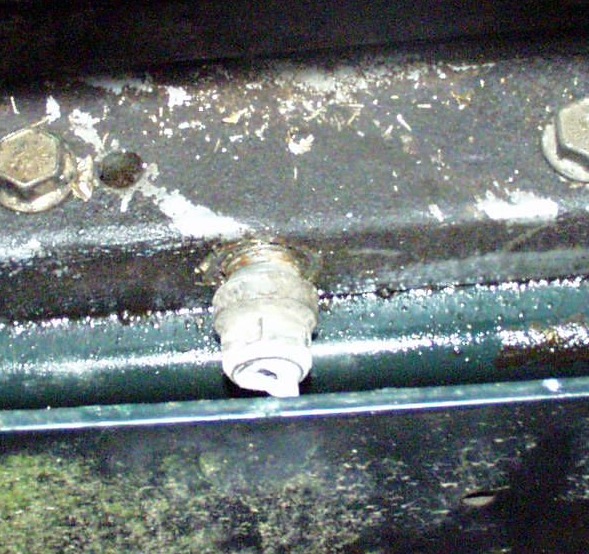
I ordered the replacement push rod, and have been plugging away at the reassembly in odd hours for a while. On Tuesday I was able to get the motor in the frame and test start it, but it ran badly and leaked oil, so out it came again. The poor running was easily diagnosed -- the needle valve had fallen out of its setting in the carburetor during one of the times I had the engine upside down during the rebuild. (Note to self-- needle valve falls out when this motor is turned upside down!) The oil leak was obvious: A brass fitting had sheared where the drain pipe attached to the engine block. The needle valve was re-set, and the stub of the fitting drilled out except for the last thirty thousandths of an inch. I went to the hardware store to buy a tap, and re-threaded the remainder of the brass to accept an undersized fitting, essentially making a thread insert of the brass.

Only problem was, my undersized replacement fitting also bought at the hardware store, didn't fit. Looking around for a suitable threaded object that would fit, my eyes fell on an old spark plug on one of my parts shelves. In went the plug. I broke the ceramic head off, for ease of fitting the motor to the frame -- the head was sticking out too far -- and called it good.

Here's a shot of the plug setting at the bottom of the engine block:


And a close-up of the repurposed spark plug itself:


I have to say that this partial engine rebuild was cathartic for me after a hard year's work as an educator. It's nice to get to do a job where success -- a well-running tractor -- is so easily defined. 

I didn't start the tractor again yet. That will be today's job -- the battery is charging. But I expect it's fixed.

Now what I need is some drier weather so I can get on with this foundation. I need to get those piers in, then get a backhoe on site to dig the cellar hole for our new extension.

Monday, May 20, 2013

More Great Farm history

From the 19th Annual Report of the Secretary for the Maine Board of Agriculture for the year 1874, found on Google Books. Click here to go to the page.


and

A hard few days' work

Friday last, the 10th, was the last day of formal classes for the year at our college and place of work. Monday morning was our Student Conference, a combination of poster session presentations, and a kind of Prize Day event, with awards for the best academic work of the year. Monday afternoon and evening, Tuesday and Wednesday were for exams and grading. That made Thursday and Friday my first official days off of the summer. So last Thursday night, of course, the phone rang and I was asked to take the college Search and Rescue team the next day to a call-out for a missing girl in Bangor. This happens only four or five times a year -- we're not a busy team like the Lake District teams I used to work with, or even Bay Area Mountain Rescue in CA. But the timing was awful, with graduation on Saturday, with the rest of the students not staying for the commencement ceremony well on their way home or home already.

I was able to rustle up one student team member, young Rebecca Z, experienced by now after three years on the team, as well as my own Rover for gear and a college twelve passenger van for people. The van proved the most useful at the search as we were able to easily shuttle large groups of searchers around all day. My group, comprised of members from various teams around the state, all experienced, ran three large grid search patterns through the woods and bogs. It was nasty thick, boggy country, but we had good folks, including a lot of guys I've worked with before, so it was easy on the brain at least -- no great efforts were needed to teach folks how to search properly.

Here's 'Becca and the team starting a grid around some cabins on Pushaw Lake:


And here''s me in the woods during a brief break, taken with the cell phone:


I'm no longer a young pup, and so several miles of grid searching swamps and thickets will tell eventually. I got back home late that evening good and tired, and went right to bed after a PBJ sandwich and two glasses of milk.

The next day I was busy all morning in the garden and dooryard, doing odd jobs and setting out sheep fence for grazing. By noon I was all cleaned up and soon on the stage at graduation, making the short little speech that the Faculty Moderator gets to make each year. It's a nice little speech, encouraging the graduates to thank their parents and teachers, and I quite enjoy giving it, but was too tired still to hang around much for the garden party afterwards. Apologies to all the graduates and alumni who wanted me to stay and chat. Aime and I got pizza on the way home. I had an early dinner and fell asleep in front of the TV twice before getting to bed early, around 8.30, but not before getting a phone call telling me that Sunday's annual SAR training, at which I was scheduled to give a talk on the new Search Team Leader training program, had been cancelled, so all the teams could instead help with the ongoing search.

Without any search team at all now for the duration of the summer, that left me off the hook for Sunday, but there was another call from my firewood source, Ricky H., who would arrive just after noon with two cords of green hardwood for me to put up. That meant I'd have my work cut out for me Sunday afternoon, since the wood couldn't be left to block the driveway. In the morning I was able to take my last large truckload of trash wood to "Brown Goods Day" at the Jackson transfer station. Brown Goods Day is the one day a year when you're allowed to drop off large items of furniture and construction waste without being charged, and for nearly a week I'd had the truck pre-loaded with the last of the "bomb dump" gubbins.

The cancellation saved Aimee a job, since she had been scheduled to take the load in while I was off giving the talk. Her plan was to plead weak womanhood, to convince the brown goods day attendants to off-load the waste for her, but in the end there was no need for such subterfuge.

Ricky's giant dump-bed truck arrived around 1pm, leaving a daunting pile of nice oak, ash and beech in our dooryard. I set to, and was able to get it all picked up. I used the tractor loader to help out a little, to push the logs closer to the pile so I could stack without also having to carry.


While this stacking business was going down, Aimee gave the dogs a bath. Earlier I'd pressure washed one of the animal water tubs for this purpose. Here's Ernie getting a good lathering.off course, as soon as the dogs are done, they go off to try to find some sheep poop to roll in, so the SOP is to confine them on the porch until they dry.


A second night's dinner of left-over pizza went down very well. I was pleased not to have to cook after stacking all that wood. But again, I fell asleep on the couch while watching Grand Designs. That's usually a show that can keep me awake, so I must have been tired.

Today's a slightly soggy rainy day, so I think I'll take it easy.