I haven''t been able to post much in the last month or so because, well, dear readers, there's just been so many things happening, there hasn't been time for me to tell you about them.
Much of the business stemmed from the fact that my sister managed to sell our mother's retirement bungalow in the Glamorgan valleys for a good price, after two years languishing on a low UK house market. (Well done, sis!) That meant that I received a modest inheritance. I'd planned to pay off the farm with it, but the recent low interest rates made that unnecessary. We refinanced last year with PenFed (one benefit of being a veteran), now have a very cheap mortgage, and don't owe very much compared to the value of our property.
Which all meant, once I'd paid off some credit cards and put much of the rest in retirement, I had a lot of vehicle work to get done.
There has been an awful lot of vehicle maintenance put on hold for want of time and money these last few years, and indeed, for want of vehicles that had any useful life left in them worth the investment. It was well past time to put this situation to rights.
This is a long story, and has been a major theme of this blog over the years. Aimee and I never have compatible work schedules, and there isn't any kind of public transportation or car pool facility available to us, so we both need our own vehicles to get to work. Aimee gets a reliable car, which in recent years was our lucky Camry. For many years now I've managed to get by using a series of end-of-life junkers, first a succession of Saabs, then the Mazda, and eventually the old Ford Escort wagon.
There's also a need for four-wheel drive vehicles in winter, and for vehicles to do farm work. Our venerable 1971 Land Rover is my winter truck, does a lot of the farm work around here, and will last the rest of my life if I take care of it. But Aimee also needs a winter vehicle, which for as long as we can both remember has been her old Nissan Frontier pick-em up truck. She also needs a vehicle for her summer field work in marine biology.
These are well-documented vehicles. The Nissan Mazda, Camry and Escort are all mentioned in numerous posts on these blog pages. The Land Rover has both blog pages and even a FaceBook page, showing the original restoration work. The most relevant to today's post, however is this one here, where I explain why the Ford needs to go to that great junkyard in the sky.
In all this long saga of beat-up old jalopies, there's one theme: How to get the maximum useful life out of a vehicle with the minimum payment. That's mostly my job, for which I have a significant array of proper tools, a small shop, and big dooryard with the appropriate shade trees for a traditional "shade tree" mechanic.
We've done quite well. The Mazda gave us over 60,000 miles for about $2,000 total, the Ford has managed about the same. The Camry has given us 50,000 for around $5,000 total, but is still going strong and has lots of useful life left in it. The Nissan, which was new when Aimee got it in 1999 while a graduate student at UMass Dartmouth, ran on and on, and gave us 212,000 miles in the end, until I foolishly burned up the transmission.
The plan was, once mother's house had sold, for Aimee to get a new car, as well as a replacement transmission in the Nissan, while I would take the Camry. The first part of this was achieved the first week in April, when we secured a "new" 2009 Toyota Matrix for Aimee. This is likely to be a reliable and cost-effective vehicle for her, and because we got it from a dealer, it even comes with a three-month warranty, the first car or truck I've ever owned that had such a thing. The mileage is especially good, at what seems around 35-40 mpg. We looked at a Prius, but were put off by the low ground clearance, as well as the high cost. The Prius mileage was only touted at 45 mpg, so the Matrix was a better deal. It also has side air bags, stability control, and ABS, all needed because Aimee isn't the world's best driver in the snow.
My experience with Toyotas, having now owned three, is that they have superior rust protection and are easier to work on because of sensible layout
Once the Matrix was in hand, I started driving the Camry. We traded the Ford Escort for a couple days of sheep-sitting from a young person with a little sheep experience. They needed a car, and the Ford can probably serve, if it passes state inspection. If not, the price of scrap is high enough these days that they can sell it and use the money for a different car. They will pick it up tomorrow.
All the cars taken care of or in hand, I then turned my attention to trucks and particularly the Nissan's transmission. With some reluctance I stripped away the old wooden flatbed decking, the result of previous efforts to keep this truck going. My intent was to clean up the frame and replace the decking at the same time as I did the transmission.
But once the decking was stripped away and I got a good look at the frame I realized there would be no new transmission for the Nissan. The frame work I'd done four and five years ago, in 2009 and 2011, had managed to last alright, but there was new rust in different places, while the cab was also rusted out at the rockers. I realized that a new transmission was not going to be such a good investment. I sold the truck for scrap, then looked for a replacement.
Both Aimee and I were a little sad the day the wrecker came. We've had this truck for a long time, and gotten a lot of useful service out of it, but all good trucks come to an end (unless they are Land Rovers).
The knowledge that the frame was gone should have made me feel better about burning up the transmission, but didn't. I hate to waste money, especially with stupid mistakes like that.
But still, I had to bite the bullet and get a new truck, so I started reading the classified and driving around to look at what was on the market.
In the end I got us another four-wheel drive Frontier, just slightly newer, a 2002. I picked it up at a wholesale lot in Bangor for five grand, plus taxes. It needs work, and I have it on jack stands in the dooryard right now, while I go through it, but it came with a cap, a tow hitch, and an extended cab, so it seats five. It has 144,000 miles already, so we know we won't get that many more miles out of it, but it only needs to do a few thousand miles a year. Most of Aimee's miles will go on the Matrix. The new truck's rear frame is rusty, and the bumper rusted out, but it's still better than the old one was when I worked on the frame all those years ago, so If I catch it now with rust converter and the wire wheel on the grinder, spray the heck out of it with undercoat, and use Fluid Film every winter, it should last for at least five years.
Fluid Film is a godsend. I should buy stock. Until I discovered this stuff, all my cars rusted out no matter what I did. It's the only thing that makes sense out of driving in a New England winter, with all the road salt used around here. Even the Land Rover would corrode if it wasn't for Fluid Film.
Plus, it's made from sheep's lanolin. What could be better?
If I get time later today, I'll take some pictures of the new vehicles to add to this post. But yes, I've had my work cut out for me recently. All this and lambing season too. (We now have six, but more are coming.)
Mother would be happy enough, though, with what I've managed to do with all her hard work and savings. In particular, as many Great Farm Diary readers know, Aimee's now expecting. I should think my mum would want her first and only grandchild to be driven in safe vehicles. I should think she'd also be glad to know how much she's helped our family financially. She was a very practical woman when it came to houses and money.
I put a lot of this in my eulogy for her, but it took a while to come true.
Showing posts sorted by date for query ford escort. Sort by relevance Show all posts
Showing posts sorted by date for query ford escort. Sort by relevance Show all posts
Sunday, April 27, 2014

Saturday, February 1, 2014
The discourtesy inspection
Aimee's muffler was making noise, so we made plans to get it fixed. In general, prying Aimee's hands off the wheel of her car to get it fixed can be hard -- she resents the loss of personal freedom. But, with gentle negotiation, and the annoyance of driving a noisy car, she was motivated and more cooperative than usual.
I made an appointment at a nearby place, but before going down there, I took a look at it myself. In general I fix most of the problems on our vehicles that can be fixed with the tools and workspace I have available, and dislike spending money on other mechanic's bills.
After no more than a moment or two's basic diagnosis I identified the source of the muffler leak as the "flex" pipe, a woven steel joint that most modern cars have between the downpipe and the catalytic converter. It was an easy diagnosis: First thing in the morning, with the current cold atmospheric conditions, and a decent flashlight, you could actually see the exhaust gas spewing out of the hole in the flex pipe.
I can change a flex pipe and indeed did so on the old Ford Escort wagon about a year ago, but in the winter, with my workshop full of woodworking tools, no lift, and no wire spool welder, this would be more trouble than it was worth. Without the wire welder I'd have to clamp the new pipe with muffler clamps, not weld it. This was not a procedure likely to outlast the Camry, while on the Ford, it almost certainly would -- and has -- just because the Ford has less useful life in it than the Camry.
My electric "stick" welder is too harsh a device to weld the thin sheet steel on a muffler, unless I have the whole muffler off and on the bench, where I can better control the heat.
So, the best bet would be to have someone else do this job.
Even so, it was with some trepidation that I put myself in the hands of the so-called mechanics at our local place. I'd already explained over the phone that the diagnosis was done and all I needed was the flex pipe. I'd asked them to make sure they had the flex pipe on hand, and asked them to be sure they could get the job done before close of business, since the appointment was for two in the afternoon. They said yes to all, but insisted that they would have to do their own diagnosis. That would be fine, I said, as long as they had the flex pipe on hand. But I again reiterated that all I wanted done was the flex pipe.
So I went down there and signed the form and gave them the key. And waited. And waited. The shop was completely empty, the staff nowhere in sight. There was no coffee for the coffee machine, and the waiting room coffee area was unkempt and dirty. Nothing to do but wait. After about thirty minutes, another car was finally pulled into a work bay, but this one belonged to a lady that arrived after I did. Her work got started, though. Mine didn't.
Finally, after about forty minutes, they pulled my car into the far bay. I could just about see what was going on.
I then watched as the mechanic toured the car with a clipboard, checking just about every damn thing but the exhaust system. Then the service manager came over with the following piece of paper, taken from the clipboard. On it was detailed the so-called "courtesy inspection".
This paper told me I supposedly needed a transmission and power steering "flush", an alignment, a throttle body clean and "bronze", a new sway bar link, a new rear bumper cover, and finally, a flex pipe for my muffler.
I hit the roof.
I told the so-called service manager that I wasn't going to pay for anything but the flex pipe, I'd already told him I wasn't going to pay for anything than the flex pipe, and could he kindly get on with the job of changing the damn flex pipe, having wasted already an hour of my time.
He said, "but it's just the "free courtesy inspection."
The kid was about fourteen years old and pimply. I expect that if I'd still been in the service, I'd have given him a proper British NCO's bollocking. I certainly felt like doing so.
I explained that it was not at all courteous, at least as far as I could see, and that they'd already wasted my time, and, again, could they please just do the job I'd asked them to do.
Then I went for a long walk to cool off.

Here's the offending piece of paper. Click to enlarge, and use control-plus to make yet bigger, forensically. The green highlighted areas are the extra stuff. I expect that the total of all these "repairs" and procedures, had I been foolish enough to allow them, would have been in excess of $1,000.
I wonder how many inexperienced car owners fall for this BS. Probably enough to make it worthwhile for the franchise owners to make it an SOP.
Even the price of the actual job, when they finally got around to doing it, was inflated.
A flex pipe could be bought at the Auto Zone down the road for less than $20. With the equipment these guys had in their shop, it would have taken me no more than half-an-hour to change it. I was charged $160. Here's the actual bill.

Finally, they charged me an extra $40 for pulling the check engine codes. I never asked them to pull the codes and indeed the check engine light wasn't even on when I took the car to the shop.
There is a stored code. I know this, because I read the codes myself whenever the check engine light comes on. There's a tiny Toyota sensor in the emissions system that senses the fuel tank pressure. This sensor is wonky, and works intermittently, goes on and off. I know all about it and have decided not to change it because a new one is $200, and the car runs fine even when the sensor is on the fritz.
So they charged me an extra forty bucks to diagnose a sensor that I already knew was bad, that I never told them to look at.
I've had enough of these clowns. It seems that every time I engage a so-called professional to do a job around here, I finish up paying through the nose and thinking at the end that I would have done things better myself. As soon as I can afford to, I'm getting a bigger workshop and a lift.
Here are some other examples:
http://womerlippi.blogspot.com/2011/08/dura-vent-or-dura-crap.html
http://womerlippi.blogspot.com/2013/01/swayed-by-bar-link.html
Monday, November 4, 2013
Busy bees
It's been a busy couple of weeks for us, even busier than our normal hectic schedule.
It all began, of course, last Christmas, when Aimee made it clear that she was hoping for the long-planned extension to get built this year. The result has been that every other job has gotten short shrift. There are only so many hours in a day and days in a week. Seasonal farming activities that would normally take days have had to be trimmed to hours, sometimes short minutes.
The biggest loser turned out to be the garden, which has been, essentially, neglected since late July. But more on that later. This latest fortnight of hectic-ness started last Thursday with the preparation for the Maine Association for Search and Rescue's second annual Search Team Leader Course. I was one of the two co-founders of this event, and the primary host, and so this wasn't something that I could skip out on, even though I would much have preferred to use the weekend spent running the training on finishing up the trim work in the new extension. The course went well, and you will eventually see some pictures on the Unity College SAR team website. (I'm still waiting to get them from the official photographer.) I was limping with arthritis for several days thereafter, though the result of some very hard hiking after a fall in which I haven''t even really walked the dogs because of work on the extension. It didn't help that I'd spent much of the previous weekend on my knees laying the floor.
So I lost a whole weekend and most of my spare time in two whole work weeks to the SAR training, so nothing happened to the extension in that period except for Aimee's shower tiling job, which has proceeded very slowly. The quality, however, is very high, and we are both pretty happy with the effect so far.
My gimp went away slowly during the work week after the STL course, and by Friday I was walking more or less normally. Saturday saw us off to Scarborough, albeit not the one in Yorkshire with the famous fair of old folk songs, but the one in Maine that, with South Portland, is home to the largest shopping area in the state. There's a store that specializes in unfinished furniture, and Aimee wanted a vanity from there for the new bathroom. This was the kind of three-hundred mile round trip shopping expedition that is quite normal for Americans, but which British people simply don't understand. We had to take my battered Ford wagon because our truck is still on the fritz with a torched transmission, and Aimee doesn't drive a stick and so couldn't drive the Escort herself. Aimee compensated me for my lost time in the car, by helping me harvest and put up the spuds. We managed to get about 150 pounds lifted and into the basement root cellar before it got dark Saturday.
Next weekend is already scheduled up with a college event. Sunday, therefore, was the only day available in which we could clean up farm equipment from the dooryard to allow the snowplow to come by, finish cleaning out the barn, put the garden to bed, and put the ram in with the ewes. Normally we would have chosen to spread these chores out over the course of three or even four weekends, but that wasn't going to happen. By cutting corners and working fast, I managed all three chores in one day. We did have a little difficulty with one of the two little ewe-lambs that are too young to be bred. She did not want to go into the barn to be separated from the others and we finished up chasing her, then cajoling her, through the door.
The upshot of all this rather frantic activity is that I'm beginning to feel caught up.
But my arthritis has also flared up again, so I'll be limping around campus all week again.
Poor old man. If you'd have managed to convince me when I was young that all that running and hiking would result in this much pain when I was older, I think I might have taken it a little easier. But back then I was bulletproof.
Now I'm just bullet-headed.
It all began, of course, last Christmas, when Aimee made it clear that she was hoping for the long-planned extension to get built this year. The result has been that every other job has gotten short shrift. There are only so many hours in a day and days in a week. Seasonal farming activities that would normally take days have had to be trimmed to hours, sometimes short minutes.
The biggest loser turned out to be the garden, which has been, essentially, neglected since late July. But more on that later. This latest fortnight of hectic-ness started last Thursday with the preparation for the Maine Association for Search and Rescue's second annual Search Team Leader Course. I was one of the two co-founders of this event, and the primary host, and so this wasn't something that I could skip out on, even though I would much have preferred to use the weekend spent running the training on finishing up the trim work in the new extension. The course went well, and you will eventually see some pictures on the Unity College SAR team website. (I'm still waiting to get them from the official photographer.) I was limping with arthritis for several days thereafter, though the result of some very hard hiking after a fall in which I haven''t even really walked the dogs because of work on the extension. It didn't help that I'd spent much of the previous weekend on my knees laying the floor.
So I lost a whole weekend and most of my spare time in two whole work weeks to the SAR training, so nothing happened to the extension in that period except for Aimee's shower tiling job, which has proceeded very slowly. The quality, however, is very high, and we are both pretty happy with the effect so far.
My gimp went away slowly during the work week after the STL course, and by Friday I was walking more or less normally. Saturday saw us off to Scarborough, albeit not the one in Yorkshire with the famous fair of old folk songs, but the one in Maine that, with South Portland, is home to the largest shopping area in the state. There's a store that specializes in unfinished furniture, and Aimee wanted a vanity from there for the new bathroom. This was the kind of three-hundred mile round trip shopping expedition that is quite normal for Americans, but which British people simply don't understand. We had to take my battered Ford wagon because our truck is still on the fritz with a torched transmission, and Aimee doesn't drive a stick and so couldn't drive the Escort herself. Aimee compensated me for my lost time in the car, by helping me harvest and put up the spuds. We managed to get about 150 pounds lifted and into the basement root cellar before it got dark Saturday.
Next weekend is already scheduled up with a college event. Sunday, therefore, was the only day available in which we could clean up farm equipment from the dooryard to allow the snowplow to come by, finish cleaning out the barn, put the garden to bed, and put the ram in with the ewes. Normally we would have chosen to spread these chores out over the course of three or even four weekends, but that wasn't going to happen. By cutting corners and working fast, I managed all three chores in one day. We did have a little difficulty with one of the two little ewe-lambs that are too young to be bred. She did not want to go into the barn to be separated from the others and we finished up chasing her, then cajoling her, through the door.
The upshot of all this rather frantic activity is that I'm beginning to feel caught up.
But my arthritis has also flared up again, so I'll be limping around campus all week again.
Poor old man. If you'd have managed to convince me when I was young that all that running and hiking would result in this much pain when I was older, I think I might have taken it a little easier. But back then I was bulletproof.
Now I'm just bullet-headed.
Saturday, August 3, 2013
Roof on -- almost -- and a fall
Yesterday was a Bad Day. It all started with the truck. The part needed to fix the transmission oil leak came in, a pipe that returns the coolant to the transmission from the transmission oil cooler in the bottom of the radiator. The old one had developed a pinhole, which led to my being stranded in Darkest Dixmont, last time I wrote.
Changing the pipe went okay, but I managed to torque the "banjo" coupling on the end where it meets the tranny. Time was when such things were welded on, solid, but this one was glued on. It didn't look like it would leak, but so I decided to goop up the seal with JB weld, just in case. I also needed some transmission fluid, so I went to Belfast, to the "big box" parts store, where both things would be available, and cheaper.
(I had tried to get the fluid on my way home from the college the day before, from our local parts store seven miles away in Thorndike, but the miserable git behind the counter had gotten surly with me again, as he often does, so I walked out, as I've done several times. I wonder how much business this place loses like this. He really is a grumpy old bugger. The only reason I still go there is because it saves me gas. If I can ever buy anything from anywhere else without wasting money on gas, I do.)
I made it home and glued up the banjo good with JB Weld, every mechanic's favorite adhesive, then filled the transmission with new oil, then took a test drive. The truck transmission was still slipping, meaning I'd likely done some damage to one or more of the bands or clutches.
This was a blow, since I had been hoping it would be back to normal once the leak was fixed and the oil topped off.
I still had two more chances. I could change the transmission filter, and/or I could use anti-slip additive.
The filter notion depended upon finding quite a bit of debris in the sump, but not too much. If there was enough debris blocking transmission fluid return through the filter, then the slipping could be due to effective lack of fluid at the torque converter, and it would go away once the sump was cleaned and the filer replaced.
The additive is always just a long shot, but worth a try. I'm sure a lot of this stuff is "snake oil", but I've actually had good luck with one or two such additives, in mechanical extremis. I checked online and picked the one that had the best reviews, by a company called Lucas.
So, another trip to Belfast ensued, followed by another greasy under-the-truck job as I changed to filter and cleaned the sump.
(All this extension-building is all very well, but when am I going to get to build the workshop I need, with the vehicle lift that would make all this greasy struggling under our far-too-numerous cars and trucks go away?)
I was impressed by how little debris there actually was in the transmission sump itself.
There was a fair amount of steel material on the sump magnet, which is put in there to catch steel debris from the clutch plates, and so give the mechanic an idea of the transmission's condition.
There was certainly enough debris to plausibly slow the oil return, so I cleaned it all out, changed the filter, buttoned everything up again carefully, added more oil and the additive, and took another hopeful test drive.
I was to be disappointed. Some of the slippage had gone, for sure, but there was still some slipping from second to third gear, as well as delay changing to fourth.
Still, it drove. That's better than having it blocking the garage entrance. And the additive may yet go to work chemically on the servo piston seals and clutch material. We'll see.
If not, we'd need to start thinking about another four-wheel drive vehicle, for Aimee to drive in the winter. This wouldn't be such a bad thing, as our official family plans, anticipating the eventual death of the truck (which at the current 220,000 miles would not be that premature), state that this would be the time to get rid of the rusty old Ford Escort wagon that I drive. I would instead inherit the Camry, while Aimee would get a newer, fuel efficient four-wheel, or all-wheel drive sedan or wagon. The Land Rover plus a trailer would be expected to pick up all the work that the pick up truck does.
In the meantime I was tired and hungry from my exertions under the truck. I cleaned up, made some lunch, and took a short nap to sleep off my disappointment at having probably fried my truck transmission.
Waking at three pm, still upset with myself, and tired, I then made the mistake of getting back up on the extension roof to lay the remaining sheets of metal roofing.
This job is safe enough when the roof is dry. The purlins make it easy to walk about up there. Even when the metal is down, as long as it's dry it's not slippy and you can move around safely.
But it had been raining earlier, and while the roof was dry, the mud around the work site was not.
I did fine for the first several sheets, probably because walking to and from the stack of roofing sheets over the grass had the effect of keeping my shoes clean of mud. But eventually most of the metal was down and there were no more handy purlins to walk on.
And, of course, as soon as I got to the very last pieces, which needed to be cut to size on the outdoor workbench, the ground around the workbench was just slightly muddy, and this material stuck to my workboots and got tracked up onto the roof. I could feel myself "losing it" just slightly, but paid no attention. It was the end of the workday, the sun was beating down, I was dripping sweat as usual, and just wanted to be done with this miserable job.
And so of course I lost my footing and began to slide on my bum towards the edge of the roof. I managed to catch on to a roofing screw with my right hand, and then the ladder with my right foot and stopped myself just in time, but I was shaken up and needed some time to recover. I climbed down very, very slowly, and haven't been back up there since.
There's more to do still, the last two pieces of roofing and then all the trim, but I think that stuff can wait for a while. It's humid this morning and the mud is still wet, while the roof itself is covered in condensation. And I'm stiff from taking the fall. All my muscles must have tensed up. It doesn't feel good.
I think I'll find myself a nice safe clean indoor job until it gets drier out there. Drywall, perhaps. Or plumbing.
I need a Good Day today.
Changing the pipe went okay, but I managed to torque the "banjo" coupling on the end where it meets the tranny. Time was when such things were welded on, solid, but this one was glued on. It didn't look like it would leak, but so I decided to goop up the seal with JB weld, just in case. I also needed some transmission fluid, so I went to Belfast, to the "big box" parts store, where both things would be available, and cheaper.
(I had tried to get the fluid on my way home from the college the day before, from our local parts store seven miles away in Thorndike, but the miserable git behind the counter had gotten surly with me again, as he often does, so I walked out, as I've done several times. I wonder how much business this place loses like this. He really is a grumpy old bugger. The only reason I still go there is because it saves me gas. If I can ever buy anything from anywhere else without wasting money on gas, I do.)
I made it home and glued up the banjo good with JB Weld, every mechanic's favorite adhesive, then filled the transmission with new oil, then took a test drive. The truck transmission was still slipping, meaning I'd likely done some damage to one or more of the bands or clutches.
This was a blow, since I had been hoping it would be back to normal once the leak was fixed and the oil topped off.
I still had two more chances. I could change the transmission filter, and/or I could use anti-slip additive.
The filter notion depended upon finding quite a bit of debris in the sump, but not too much. If there was enough debris blocking transmission fluid return through the filter, then the slipping could be due to effective lack of fluid at the torque converter, and it would go away once the sump was cleaned and the filer replaced.
The additive is always just a long shot, but worth a try. I'm sure a lot of this stuff is "snake oil", but I've actually had good luck with one or two such additives, in mechanical extremis. I checked online and picked the one that had the best reviews, by a company called Lucas.
So, another trip to Belfast ensued, followed by another greasy under-the-truck job as I changed to filter and cleaned the sump.
(All this extension-building is all very well, but when am I going to get to build the workshop I need, with the vehicle lift that would make all this greasy struggling under our far-too-numerous cars and trucks go away?)
I was impressed by how little debris there actually was in the transmission sump itself.
There was a fair amount of steel material on the sump magnet, which is put in there to catch steel debris from the clutch plates, and so give the mechanic an idea of the transmission's condition.
There was certainly enough debris to plausibly slow the oil return, so I cleaned it all out, changed the filter, buttoned everything up again carefully, added more oil and the additive, and took another hopeful test drive.
I was to be disappointed. Some of the slippage had gone, for sure, but there was still some slipping from second to third gear, as well as delay changing to fourth.
Still, it drove. That's better than having it blocking the garage entrance. And the additive may yet go to work chemically on the servo piston seals and clutch material. We'll see.
If not, we'd need to start thinking about another four-wheel drive vehicle, for Aimee to drive in the winter. This wouldn't be such a bad thing, as our official family plans, anticipating the eventual death of the truck (which at the current 220,000 miles would not be that premature), state that this would be the time to get rid of the rusty old Ford Escort wagon that I drive. I would instead inherit the Camry, while Aimee would get a newer, fuel efficient four-wheel, or all-wheel drive sedan or wagon. The Land Rover plus a trailer would be expected to pick up all the work that the pick up truck does.
In the meantime I was tired and hungry from my exertions under the truck. I cleaned up, made some lunch, and took a short nap to sleep off my disappointment at having probably fried my truck transmission.
Waking at three pm, still upset with myself, and tired, I then made the mistake of getting back up on the extension roof to lay the remaining sheets of metal roofing.
This job is safe enough when the roof is dry. The purlins make it easy to walk about up there. Even when the metal is down, as long as it's dry it's not slippy and you can move around safely.
But it had been raining earlier, and while the roof was dry, the mud around the work site was not.
I did fine for the first several sheets, probably because walking to and from the stack of roofing sheets over the grass had the effect of keeping my shoes clean of mud. But eventually most of the metal was down and there were no more handy purlins to walk on.
And, of course, as soon as I got to the very last pieces, which needed to be cut to size on the outdoor workbench, the ground around the workbench was just slightly muddy, and this material stuck to my workboots and got tracked up onto the roof. I could feel myself "losing it" just slightly, but paid no attention. It was the end of the workday, the sun was beating down, I was dripping sweat as usual, and just wanted to be done with this miserable job.
And so of course I lost my footing and began to slide on my bum towards the edge of the roof. I managed to catch on to a roofing screw with my right hand, and then the ladder with my right foot and stopped myself just in time, but I was shaken up and needed some time to recover. I climbed down very, very slowly, and haven't been back up there since.
There's more to do still, the last two pieces of roofing and then all the trim, but I think that stuff can wait for a while. It's humid this morning and the mud is still wet, while the roof itself is covered in condensation. And I'm stiff from taking the fall. All my muscles must have tensed up. It doesn't feel good.
I think I'll find myself a nice safe clean indoor job until it gets drier out there. Drywall, perhaps. Or plumbing.
I need a Good Day today.
Friday, February 8, 2013
A storm approaches
The local (Bangor, Maine) TV news and weather team was on full alert last night -- they did that thing they do when a storm is coming or overhead, where they go first to the weatherman, instead of telling us about all the latest house fires and murder trials.
That means the weather itself is top of the news.
In this case, the NWS is calling for a couple feet of snow in our part of Maine in less than 24 hours. It's supposed to arrive later today, rapidly get worse, snow all night and Saturday morning, and then clear out for Sunday.
Two feet of snow is a fairly regular occurrence around here. It happens maybe once a winter, say two out of every three winters, or something like that. I can remember several two-feet snowfalls since we moved to the Great Farm.
And it doesn't seem like class is going to get cancelled. The snow will arrive later this afternoon or evening, after school is done for the day.
But still. Best be ready. I put the generator battery on a charge last night. I should now switch the charger to the tractor battery. The tractor's fuel tank may be low. I'll check that today. I may need to buy some kerosene for the tractor on my way to work.
This might be a good day to drive the Land Rover to work myself, and have Aimee drive the four-wheel drive Nissan pick-em up truck. I've been driving the truck every day this week, since the Ford Escort sprang a brake line leak. I haven't had the time to fix the Ford, and I doubt I'll do any such thing this weekend or for several weekends to come. It doesn't make sense to me that I should hurry up to lie on the frozen ground under a rusty old Ford car to change a brake line, when I still have a Land Rover and and pick-up truck to drive.
I'll be glad to get home from work later today. Not only is it a Friday, but with a blizzard coming, this is no day to have to go anywhere.
That means the weather itself is top of the news.
In this case, the NWS is calling for a couple feet of snow in our part of Maine in less than 24 hours. It's supposed to arrive later today, rapidly get worse, snow all night and Saturday morning, and then clear out for Sunday.
Two feet of snow is a fairly regular occurrence around here. It happens maybe once a winter, say two out of every three winters, or something like that. I can remember several two-feet snowfalls since we moved to the Great Farm.
And it doesn't seem like class is going to get cancelled. The snow will arrive later this afternoon or evening, after school is done for the day.
But still. Best be ready. I put the generator battery on a charge last night. I should now switch the charger to the tractor battery. The tractor's fuel tank may be low. I'll check that today. I may need to buy some kerosene for the tractor on my way to work.
This might be a good day to drive the Land Rover to work myself, and have Aimee drive the four-wheel drive Nissan pick-em up truck. I've been driving the truck every day this week, since the Ford Escort sprang a brake line leak. I haven't had the time to fix the Ford, and I doubt I'll do any such thing this weekend or for several weekends to come. It doesn't make sense to me that I should hurry up to lie on the frozen ground under a rusty old Ford car to change a brake line, when I still have a Land Rover and and pick-up truck to drive.
I'll be glad to get home from work later today. Not only is it a Friday, but with a blizzard coming, this is no day to have to go anywhere.
Tuesday, August 14, 2012
Done Roving! (For now)

After much tinkering with a worn-out Zenith 36 IV carburetor, I got the Rover's engine running pretty good, and decided to declare the great Land Rover Restoration Project of summer 2012 finished.
I celebrated with a Facebook photo album of the project, which you can find here:
The original goal, which was to replace the functionality of the 1997 Ford Escort Wagon and the 1999 Nissan pick-em-up truck, can be partly met with this vehicle.
The main barrier to completely meeting the goal is the poor fuel efficiency of the Rover. The Escort gets about 35 mpg minimum, while the Land Rover currently gets less than 20. The Ford will have to keep running for now, since we can save money by using it for me to get to and from work and for non-load carrying trips. I'm hoping to increase the fuel efficiency eventually with a new carburetor.
But with the addition of a solid farm trailer, we'll be able to do everything we do with the Nissan, when that vehicle finally poops out as it must in a year or two, at the most three. I think we'll eventually scrap both Nissan and Ford and replace them with a fuel-efficient sedan or hatchback of some kind, possibly a second-hand Prius for Aimee to drive, while I take her Camry into its second 100,000 miles.
There are a few things we can do with the Rover that we couldn't do before. One is to carry dogs very easily. In fact, the dogs really like it in the back of the Rover. They have their own rug on the floor and their own windows to look out of. We can also install a section of fence back there, pull out the rug, and carry sheep and piglets without the need for a livestock trailer, which will be very convenient.
And, as long as the Nissan keeps running, when the snow flies Aimee can drive the Nissan, while I drive the Landy, allowing us to keep different schedules even when the weather is bad.
The total cost of the Land Rover, including parts, registration and new tires, was somewhere between five and six thousand dollars, which I think is not bad for a four-wheel drive truck that can last for many years. We spent about that much on Aimee's Camry a couple years back.
Saturday, July 14, 2012
"Tango 3 to Tango Base, I've turned the Rover over, over."

That was the (alleged) radio call made back from a country bridge to the RAF Mountain Rescue Base camp at Mungrisdale in the English Lakes one fall in the early 1980s. I confess, I was the hapless young driver who skidded on the ice patch, and ruined one of Her Majesty's Land Rover cars.
Soon after that they took my military driver's license away, never to be returned. Ouch!
But here we are durn near 30 years later and there's another short wheely Rover sitting in my dooryard here on our farm in Maine. How did that happen?
It has a few problems and indeed the first thing we'll do is to strip it down to the frame and grind off some rust and old paint and weld some patches in here and there and repaint in some kind of very utilitarian rust-proof paint. We'll also need a compression test, a full tune-up, and possibly a complete rewire job.
All of which sounds like a very fun rest of the summer to me.
And at the end of it all we'll have a farm truck and local run-around car that ought to last for twenty more years. Much needed, since I just found terminal rust and a very poor set of brake rotors and calipers on our 1997 Ford Escort, and since the Nissan can't possibly last more than two or three more years.
That's way too many dollars to invest in the Ford's brakes, given that it also needs a clutch and a timing chain (based on the mileage -- both are currently working fine), so we'll do what we can with a $12 set of pads and some elbow grease and then just run out the remaining life in the car before scrapping it. One, at the most two more winters.
We'll put our money in the Land Rover instead. It should keep its value and even improve in condition and reliability over the years as I plug away at it.
One day we'll even send away to Sheffield for a galvanized frame.
I'll die before this truck does.
"It's never over with a Rover."
Hats off to Aimee for believing, or at least pretending to believe in the Land Rover project. I've officially used up my stock of wifely patience for the year, plus all my birthdays and Christmas presents for the forseeable future.
Although she did seem to have a wee moment when she saw the seats in the back and the holes in the floor.
"Adds character!"
By the way, don't worry: Those awful non-original equipment roll bars are going to be the first thing to go!
Saturday, August 27, 2011
Other updates

 Other than the excellent news that the pigs went quietly, lots more has happened, good and bad, around the farm.
Under "good", our lamb and sheep management has paid off in spades for pasture quality for the first time ever.
In the past, we've always found ourselves with too much head of stock by the time the grass starts to slow down in the fall, and as a result we get overgrazing, and need to supplement grass with hay and grain earlier than is cost-effective.
You have to give a little grain. This time of year the less hardy breeds of sheep need a little supplemental grain if you're to get good lamb numbers.
Hardy types, Herdwicks and Swaledales and Welsh Mountains can pretty much fend for themselves year-round if there's winter grass, and indeed that's the proper management for those breeds in Britain.
Here in Maine, we'd ordinarily give the hardy breeds a winter shelter and just hay.
But slightly less hardy types like our Corriedales need a little grain before breeding, if you want to have high lamb productivity, lots of twin lambs. This is called "flushing." I began graining our ewes and lambs lightly a few weeks ago, for flushing, and to keep the shearlings and yearlings in good condition for sale.
The sale animals went for a decent price, which, with the weaner lambs sales in spring and the one fat lamb sale, also a few weeks ago, and last but not least my project of culling the large number of superannuated ewes we used to keep; all this reduced the flock count to ten, down from sixteen.
The pastures were looking tired so the remaining sheep went into the North Paddock and onto hay for a short while to give them a rest. A bit of rain and some sunshine later and we have grass in abundance, and fewer sheep to eat it. Our ewe-lambs are fat and fluffy and happy as a result. In a few weeks time we'll catch them for dagging and hoof-trimming, and check their eyelids, and I don't expect to see any anemia, except perhaps for Nellie who seems unable to fatten this year for some reason. I've already drenched her once, and am not sure what else to do except perhaps to give her a rest year. Her twin lambs are still nursing, the greedy buggers, and once they stop, or she gets wise and makes them stop, she may have a little more to spare for herself.
In other "good" news, Aimee had a birthday, although I'm not sure how good she feels about getting older. She liked her presents for once, especially that cute little lime-green li-on screwgun I bought her.
Aimee loves her tools. Must have gotten that from her dad.
In bad news, with that recent rain that helped the pastures, the late blight has struck again and we'll lose ninety percent of our tomato crop. I walk around the tomato patch looking for odd berries that have escaped the fungus, and it's just a miserable feeling. I love my tomatoes so much. I get that from my Dad, I know, and my grandfather, both of whom raised tomatoes every year.
The potatoes, otherwise susceptible (Phythoptera infestans is the "potato" blight after all), will be fine as long as I leave the harvest until after the first killing frost. The fungal spores don't penetrate the ground unless you disturb it, or unless the blight hits while the tubers are first forming.
And the potato productivity is well up. One plant alone that I pulled for eating now produced a five-gallon bucket full. We also have plenty of other vegetables.
And we have lots of apples, mostly because of a piece of bad news. A storm Monday took out our best eating apple tree, a big, tippy, split-trunk disaster of a tree that just happens to produce nice big Golden Delicious-type apples. This tree, overgrown like all the many apples we have, was on my list to be deadheaded -- pruned back to a pollard. They all are eventually. This was just higher on the list. But I postponed the job until I could see what the results of this very harsh treatment would be on the Granny Smith-type in the front yard. I cut that tree back to a near-pollard several years ago, and thus far there had been no apples to speak of. A few appeared this year. Until I know how long it takes to get a tree back into production, I can't put them on a rotation for deadheading.
The problem is, we really don't know, and probably can't ever know, what varieties we have here, or whether or not they were grafted, and so it's very hard to know if or how to prune them.
When I say they produce "Granny-Smith" style apples, that just means the apples look and taste like modern Granny Smiths. In reality, the tree is probably some much older, forgotten variety.
The orchard plantings probably took place between 1806, when the farm was begun, and 1880, when the original Great Farm mansion burned. What we have are likely the daughters and grand-daughters of the original and later plantings. Some of the trees we have would have been deliberately cultivated, others would be volunteers. At least a couple are obvious grafts, such as the two-trunker in the Back Forty, where one trunk produces some kind of Russet, while the other has pale yellow, sweet eating apples of some other kind, possibly the same kind as the tree that just fell. We can guess that any grafted tree was deliberately planted, and so dates back the last time this place had a serious and knowledgeable farmer or farm manager. The Granny Smith, fifteen inches or more at the base is also probably 150 or 200 years old. Others are likely fresh "sprouts" of 50 or 75 years only.
Anyway, long story short, my favorite apple tree came down in a storm, weighed down by lots of fruit. Neighbor Hamilton was the one to find out when his morning run was blocked by the tree fallen across the fence, and the sheep were out as a result.
He was good enough to clear the tree for me and even managed to round up most of the sheep. I came home to find him trying to get the rest put away. I relieved him of that duty, and then we finished clearing his driveway together. After that I stripped all the good apples off the down branches and pruned what was left of the tree back to a kind of triangular pollard, where the main trunk leaves the ground at 45 degrees, and the one remaining branch turns back at a steep angle to balance the trunk. The sheep were then set to clean up the hundreds of smaller wormy apples, which job they have not been able to complete.
Other bad news, I think I have a CV joint going out on the Ford Escort wagon, and so am considering doing that job and some other body and brake work to get the car in good nick for the winter. I went through our superannuated Nissan farm truck pretty thoroughly this summer, so that vehicle is now my daily driver while I decide what to do with the Ford.
And last but not least, we will get a hurricane or a tropical storm sometime Sunday or Monday. Monday is also the first day of class, so we may finish up with a search and rescue call-out on the first day of class.
Monday, March 7, 2011
And it begins...
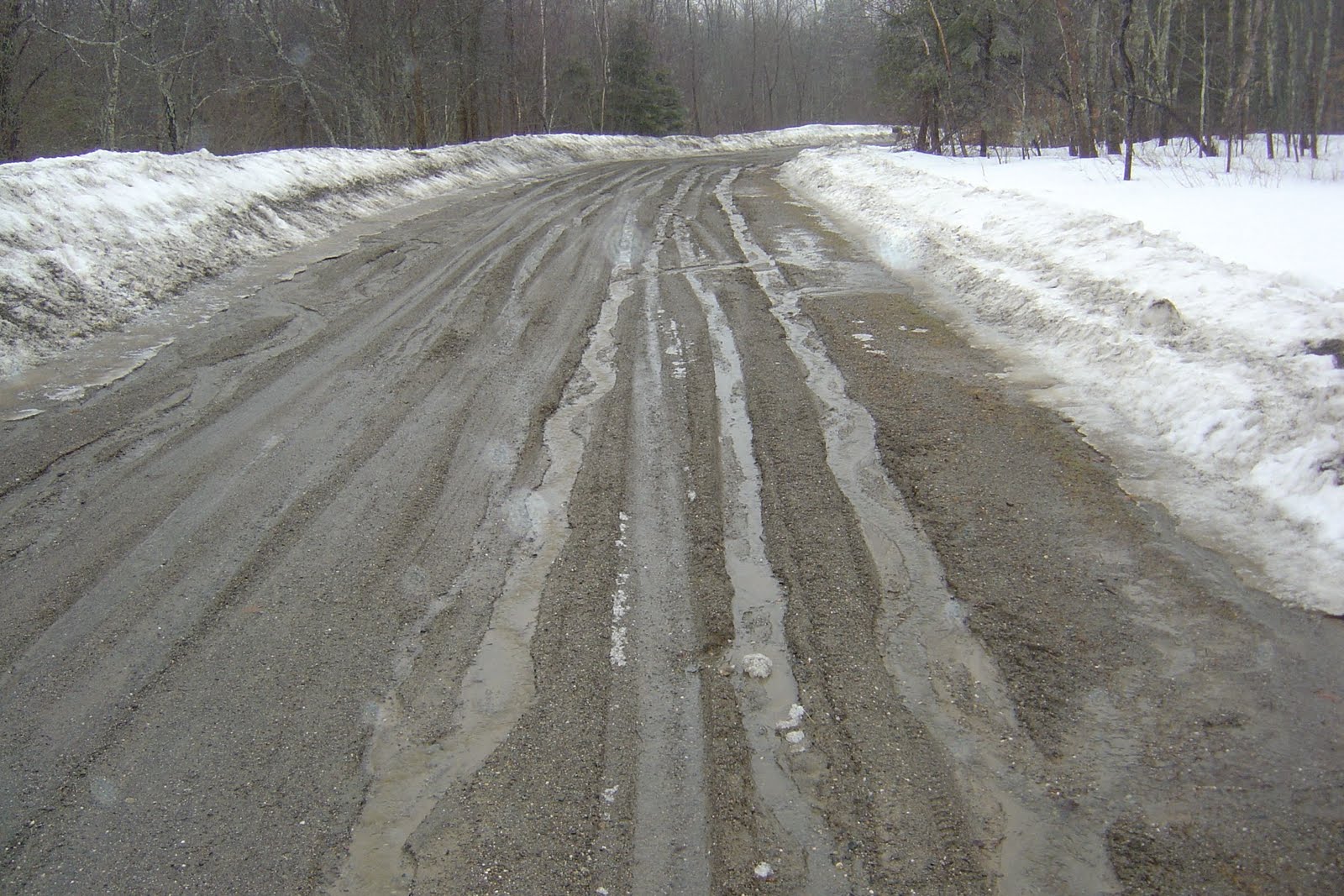
 Mud season.
That's what Mainers call the time of year when the air is above freezing, but the soil down below remains frozen and is therefore impervious to drainage.
Not that Maine drains particularly well any time of year. Maine is designed to drains slowly if at all, a big wetland sponge that soaks up millions of gallons of fresh water and releases it only slowly to the Gulf of Maine. Providing homes for all kinds of wetland critters in the process, including mosquitoes and blackflies (the Maine state bird) as well as frogs and fish.
But it doesn't drain much at all in mud season.
Our mud season began officially a couple days ago with our first rainstorm in several months. But that was just a taster. The couple inches of rain we've had in the last ten hours were the real thing.
In the middle of it all the rain turned briefly to ice and then back to rain. there were a couple inches of ice on power lines earlier today and we had one short outage sometime early this morning. But power is back on now.
This birch tree on our neighbor's lawn was suffering more than other trees. After a bending like this it may not spring back.
There's a birch in front of our house with a perfect ninety degree bend from a storm two years back. I keep asking Aimee if I can cut it down for firewood, since it will never grow straight again and will eventually fall over, but she likes it for some reason.
Aimee ran out of bleach and sent me to the grocery store to get some for the wash and her spring cleaning project which is ongoing (and terrorizing man and beast around here). So bravely Sir Mick went out in his trusty Ford Escort steed, sliding down through the muck on Great Farm Road and spinning back up it, skidding from one side of the road to the other.
I did wonder if wrecking a perfectly good car was a good trade for a gallon of bleach, but I soon put away such rebellious thoughts. And we didn't wreck.
Although the trip was more stressful than a trip to the store has any right to be.
Wednesday, November 24, 2010
Doing Sweet Fanny Adams

Photo: Today's celebratory breakfast, otherwise know as cardiac-emergency-on-a-plate. See below for provenance.
In UK slang (of 25 years ago or more), that phrase (doing sweet Fanny Adams) means doing nothing much at all. Which isn't quite true. We've both been doing things. But we've been doing them at our pace and more or less on our schedule, with large bouts of rest and proper amounts of exercise.
And I am getting over that cold.
So things are in much better shape than they were. We're getting it "sorted," and will be happy enough to go back to work and finish up the semester.
Funnily enough, and speaking of UK slang, my lovely and very American wife asked me yesterday when I came back from my job delivering the meat to the Womerlippi Farm pig club members, whether I'd "got the pigs sorted."
Hah! She's becoming British-ised.
(The reverse of Americanized, spelled with an "s" instead of a "z," of course.)
Funny, that. I wonder where she picked that up? That useful truncated phrase, "sorted" (for "sorted out") was not actually part of the internal lexicon of UK slang I bought with me to America in 1986. I picked it up myself since then, from TV or from visits home. And now Aimee has picked it up from somewhere too, most likely me.
Imitation is the sincerest from of flattery. But now I've written that, we'll know if Aimee reads this because she'll never use it again. She's that kind of stubborn.
So what have we done since our vacation started?
Saturday, as reported below, was largely rest. Sunday saw me drive over to the Bale House to investigate problems with the solar power system. The new occupant had reported difficulties over the last week or so. It took me some dithering with a multimeter to narrow down the problem, and indeed, I went back again on Tuesday before I had it completely isolated, but it was definitely the Cobra 1000 watt inverter, which we installed as part of the general repair after the much higher quality Trace 600 watt inverter was fried because the former occupants disconnected the ground wire.
I had managed to soak this new inverter thoroughly with water during the plumbing repairs, and so I wasn't surprised to see it quit on us. Either the soaking, or the fact that we've been using it to run a small 110 volt pump that draws quite a bit of power, resulted in the control system developing an intermittent fault. When you turn the inverter on now, nine times out of ten or so, it goes to directly to the low voltage override, even when there's a decent battery charge. Of course, I had to prove to myself that the batteries were not actually providing low voltage, which took a full day of sun.
I ordered a new inverter, another Cobra, a bit more powerful at 1500 watts, but I won't throw the old one away until I've taken it apart and looked for water damage or a loose connection.
So that was what I did on Saturday and yesterday morning, which is to trace and solve electrical and electronic faults at the Bale House, including the failed phone line. You wouldn't think that a primitive, off-grid, home in the woods would require that much technology, but it does, for the simple reason that all the power supply equipment, and all the phone equipment and the phone line until you reach the connection on the telephone pole on the road a thousand feet away, well, it all belongs to us, not the power company or phone company.
So we have to fix it if it breaks.
I can't actually remember what I did Monday. Brain fart. Senior moment. Put me in the Aberdare General next to me old mum.
Now I remember. I bought two new tires and an oil change for for Aimee's Camry. Took all day, too, to get the work done. But it was raining, so it didn't matter much.
Tuesday afternoon was the great annual Womerlippi farm pork product distribution day. I motored in the pouring rain over to Maple Lane Butchers in Charleston, Maine, where I picked up a full Ford Escort wagon-load of assorted pork and smoked pork product. Then I motored back to Jackson, where I stuffed the first pig, all seventy pounds or so, into our own freezer. The second and third pigs then went to the other pig club members in Unity and Freedom. Of course, they didn't drive themselves.
The great annual North Waldo pig tour.
(Don't you love all the wonderfully utopian names of villages and towns in Waldo County, Maine: Unity, Hope, Freedom, Liberty, Union, and my personal favorite, Albion. The reason we have such great names is because the Maine frontier was settled by "Liberty Men," Jeffersonian Republicans, many of whom fought in the Revolutionary War. They bought land from, but hated, the great proprietors such as Israel Thorndike, who made the original Great Farm.)
The pig club members were pretty happy to get their pork.
I was a little disappointed in the quantities: the three pigs came in at 166, 173, and 177 pounds, respectively, which is a good weight for lean pork, but produced much less total dressed weight than last year's four 200 and 210 pounders, for what seemed like about the same amount of feed. And I don't mind eating fattier chops. I quite like them, if they're properly done. But we started a month later, with smaller piglets to boot, and although it seemed like we gave them plenty of feed, we probably fed less total because there were only three and not four pigs and because we fed them for a month less. The numbers will tell all, when I do the receipts in March, for the taxes.
But, slight disappointment aside, the reward for all this piggery pokery was, of course, pork chop and mashed potato and pickled red kraut for dinner. Sehr gut, danke.
And now, today, our own bacon and eggs and tomatoes for breakfast. I haven't had any bacon for four months, since we ran out.
Once you've tasted your own, you'll never go back to store-bought.
Today's job is to trace a clunk in the Camry's suspension, seeming audible only to the female of the species, as well as to pick up our Thanksgiving turkey from our 16-year old Amish farmer.
Thanksgiving, in PA Dutch.
Veilen danke.
Saturday, May 15, 2010
How do you know how to do the right thing?
Well, yesterday was an almost perfectly difficult day, but those are common enough around here. What was different was that it was a day of almost complete moral ambiguity.
Only time will tell if we did the right thing.
This difficult day involved both sheep and cars, but both stories are long, so bear with me.
The first part of the day we spent car-shopping. I've mentioned before that our truck has developed a coolant leak into one of its cylinders, most likely a head gasket leak, but possibly a warped cylinder head. This truck is Aimee's daily driver and life is hell around here whenever it has to be taken out of service for repairs. Aimee and I never have matching teaching schedules, an administrative problem that costs us a small fortune since it means we have to keep and drive two vehicles constantly. One of us has to come home as early as possible to tend animals, the gardens, and in winter, the wood stove. The other, usually Aimee who has considerably more administrative duties, has to stay late. It buggers up all our house and farm systems terribly, and worst of all, animals get neglected, if I have to stay on campus to wait for Aimee to finish up.
So we drive two vehicles almost daily, all year. If we're going to do this, we really should get the most fuel efficient and cost-efficient vehicles we can. Aimee, who can't drive a stick-shift, drives the automatic truck, while I drive a manual Ford Escort wagon. If there's a snowstorm or other bad weather, we do drive together in the four wheel drive truck. We also need it for moving hay, grain, and other bulky farm inputs. But the rest of the time we drive separately unless for some strange reason that's a day we can both leave for work and come home at the same time.
So as mechanic-in-chief around here, and in consideration of the truck's essentiality and usefulness around here, my advice was for us to keep it and repair it and baby it along as long as we could, but only use it when we actually need a truck or four wheel drive, and instead get a smaller car with an automatic transmission for Aimee to drive to work. Actually, we probably made this decision last fall, or earlier, before the truck had even developed the head gasket leak. But the leak clinched it and added urgency, since a vehicle with such a deep, systemic engine problem can crap out any day, any time.
Which sent me to my budget spreadsheets and the classified ads for about the last two months, while I explored the possibilities for buying new or used small cars more or less exhaustively. We can't afford to throw money at vehicles, and while new cars are nice, they aren't necessarily the most cost-effective choices. As a fairly experienced mechanic, given enough time, I can repair almost anything on a car myself. I rarely have time for car repairs during term time, but in summer I can usually pull out several days and even weeks or work on vehicles. In fact last summer I reconditioned an old motorcycle just for fun. If I have lots of time, I even enjoy the work.
This gives us some options other folks don't have.
Long story short, we looked at new small Japanese cars, like the Fit, Yaris and Versa. We even looked at the Chevy Aveo, but Aimee, suspicious like many Americans of American car manufacturers, didn't like that much. I thought about it for a while, the appeal of a car and warranty for less than $11,000 being quite strong, but the Aveos don't hold their value at all, and I'm not sure they're good for much more than 120,000 miles, whereas the Japanese models get 200,000 or more. Aimee fell in love with the Fit. All that neat cargo room and secret compartments appealed to her organizing nature. But we couldn't imagine spending $18,000 for a tiny hatchback, even if it was likely to get 200,000 miles.
More cost-efficient in comparison were second-hand cars, but not so much the smaller Japanese ones. We actually saw secondhand Honda Fits priced for more than new ones at one or two dealers, less Fits being made than were demanded by buyers.
So after quite a bit of winnowing of ideas and back and forth, we settled on finding a small to mid-size Japanese car, preferably smaller, but not necessarily so, hopefully with less than 100,000 miles, but not necessarily so, and so on. The main criteria being overall value for money. I badly wanted to make a Prius fit this profile because of the fuel economy factor, but that rapidly showed itself to be almost impossible. There was one "little old lady" Prius that sold for $6,000 last week with only 59,200 miles on it, but after careful perusal of the ads and after looking hard and driving one car, I decided that if a Prius was priced for less than $10,000, it was either because it was approaching 200,000 miles, or because it had a dead or suspect main battery costing $3,000 to replace.
We weren't getting anywhere with all of this and we'd only looked at one car by the end of the semester.
Then Aimee spent an hour or two online one night and found a few cars she wanted to go see, and, probably because she picked them out herself, gave me absolutely no trouble in scheduling a day to go see cars. Usually she hates to go car shopping, and will avoid it like the plague, so this was progress, and hopeful.
So I made a list of cars, and planned out a route. We drove first to Lewiston, Maine, where we had scheduled a look at a '97 Toyota Camry. This car, otherwise ancient, somehow had only 44,000 miles on it, asking only $4,000 when the blue book value was $6,500, almost unbelievable, and I wanted to see if I could fault the theory somehow.
So I rolled under it, and prodded it here and there, and listened to the engine, and smelled the exhaust, and tried to find a reason not to buy it. Aimee drove it, I listened and felt with my butt for bad suspension noises. The damn thing was cherry, more or less. Original paint, bodywork, barely a scratch, and no worn seats or key-scratches or any other reason to suspect those 44,000 miles. Disbelieving, I got fixated for quite a while on the fact that there was new underseal on the frame, and I wanted to know why. There were some seams under the thickest coats of underseal on the main box members, and I wondered if it had been welded, or worse, packed with bondo. The guy who was selling the car had been a dealer but was now unemployed, and I was, I admit, a little more suspicious just because of his former occupation.
This suspicion on my part led to a ludicrous moment where we pulled into a Marden's parking lot while I rolled under someone's random Camry to compare the frame seams. Thank you for that, whoever you are, and I promise I never actually touched your car.
I was only looking, your honour, honest I was.
But the frame was sound, just like every other Camry frame, only cleaner and with more underseal. And so in the end we bought the car. The paperwork took half the day, what with a bank loan and insurance and transit plates. We eventually, very eventually, had all the legalities straightened out, and Aimee, by this time just seething with frustration at how long everything had taken, more or less grabbed the keys from me and finally drove the car off the former owner's driveway.
But we had to get gas. And I'd warned Aimee over and over how there was going to be something wrong, that this was too good to be true, and that old cars that don't get use much develop their own kinds of problems, like dried-out seals and so on.
Well, we were putting the gas in and I was wondering what size gas tank a Camry had, 13 gallons, I thought aloud. Aimee said no, the pump gauge was reading more than that, and then, oh no, we saw the gas trickling onto the floor. A leaking gas tank.
All of a sudden, I actually felt better. Finally, a reason why the car was priced so low. Aimee, on the other hand, was feeling pretty low. But I looked at the leak pretty hard, and decided it was coming from the filler neck, not the tank, and that if we just drove away some of the gas in the tank, and if we were lucky, it would stop leaking, and while we might cause some air pollution, the day was warm and dry and the leaking gas would be spread pretty thin across all of Maine and would evaporate. It helped my thinking that I'd earlier bought comprehensive insurance for the car. But common sense dictated that if anyone was going to die in a blazing vehicular inferno, it would have to be the male of the species, the disposable sperm deliverer, not the female egg carrier. Plus if anyone has experience driving dangerously defective vehicles by the seat of their pants, it's me.
So we drove home, slowly, but steadily and uneventfully. And at about one-third down the gas gauge, the tank stopped leaking. And nothing else seemed particularly wrong.
So did we do the right thing? Only time will tell. The only thing I know for sure is that we have a new, and fairly new-looking car in the driveway alongside our two existing beaters. And that there's a faint whiff of gas in the Great Farm neighborhood. I will be working on the gas leak today, and if I get that fixed in a timely fashion I will do some other things like pull the wheels and check the brakes and pull the plugs and so on, anything I can do to look for wear indicative of more than 44,000 miles.
But that's not the end of the day's ambiguities. About a half an hour after we'd settled down after all this excitement, the phone rang again. Another sheep call. I'm not sure I know how I became the go-to sheep "whisperer" in the area, but that sure seems to be what has happened.
So I pulled on me dungerees and wellies and went a mile or two up the road to another sheep farm, different than the last, where another Churro ewe had been in labor all evening with a tightly packed lamb.
Where I encountered the tightest ewe's vagina and uterus I've ever seen. I could bearly get a finger past the labia, let alone the cervix. The lamb was almost certainly past saving, its tongue bloated with asphyxiation. The ewe was healthy, but in a poor fix.
I struggled for about half an hour, first as gently as I could but eventually with more and more force. I was able to get one foreleg out, but not the other. I couldn't even find it, but then I couldn't get in past the head without tearing tissue. And I couldn't push the head back at all, to reposition the lamb's legs. It wouldn't go back, and as I tried I felt the lamb's teeth breaking and jaw tissues tearing. So I just pulled, while the owner pushed on the belly. There were no contractions, although the ewe would push a little. But the lamb wouldn't budge.
Eventually, I used so much force, I pulled the foreleg right off the dead lamb. That was gruesome. But even then, the remainder stayed put, not moving at all, the lamb's shoulders jammed tight in the womb. Normally, you could pull a lamb like this out easily enough, once you got a grip on a leg or two, but not this time.
I've never had a case like this. The only solution, and probably what we should have done as soon as we realized how tight the lamb was, would have been a cesarean section. But there was no way to succeed at that without a lot of pain and risk for the ewe. Even if there had been a vet willing and available to come out, which I strongly doubt, there would have been more pain and delay.
Which was a pitiful shame, since this ewe was bright and alert and well, just lying there with a lamb that wouldn't come out. We thought about cutting her open in case there was a second lamb, but that just seemed like throwing mortal insult after mortal injury.
So the man of the house went for his pistol and I shot the ewe in the head and she died. More slowly, too, than I would have liked, for the heart kept pumping for several minutes. But I'm sure she didn't feel anything by then, with most of her brain messed up.
So, more moral ambiguity. Did I do the right thing? Should I even have offered to help? I honestly don't know. I'm not a vet, and not even really a very experienced sheep midwife, just more experienced than other folks around here fell themselves to be. The owners were somewhat out of their depth, but so was I. I just felt more comfortable being out of my depth, is all, and for no particularly good reason except I seem to have found myself out of my depth fairly often in my life and have got more used to it than perhaps I should.
The only thing I know for sure is the ewe is now feeling no more pain.
In both cases, the car which is vital for our family, and the ewe's life, vital for her, the stakes were fairly high. These settings we encounter with our rural and self-reliant way of life come with this effect: the stakes are often higher than most folks, particularly most Americans, normally come across in the developed world.
In fact, when stakes do get to be that high, or more so, such as with my elderly parents, both now in hospital in Wales, the system we live with tends to take responsibility from us and give it to specialists.
I'm not sure this is such a good thing for society, not all of the time at least. I may not feel that good about yesterday's problems, or how we muddled through in dealing with them, but at least we did deal with them, all of them. And we even resolved them, in our own fashion, for better or for worse. And we'll deal with more problems today and resolve them too.
There are plenty of problems around the world that are not being dealt with and are not likely to get resolved at all, possibly because we fail to take responsibility or to act, both individually and collectively. And so problems pile up.
Until they get to be really big problems.
Only time will tell if we did the right thing.
This difficult day involved both sheep and cars, but both stories are long, so bear with me.
The first part of the day we spent car-shopping. I've mentioned before that our truck has developed a coolant leak into one of its cylinders, most likely a head gasket leak, but possibly a warped cylinder head. This truck is Aimee's daily driver and life is hell around here whenever it has to be taken out of service for repairs. Aimee and I never have matching teaching schedules, an administrative problem that costs us a small fortune since it means we have to keep and drive two vehicles constantly. One of us has to come home as early as possible to tend animals, the gardens, and in winter, the wood stove. The other, usually Aimee who has considerably more administrative duties, has to stay late. It buggers up all our house and farm systems terribly, and worst of all, animals get neglected, if I have to stay on campus to wait for Aimee to finish up.
So we drive two vehicles almost daily, all year. If we're going to do this, we really should get the most fuel efficient and cost-efficient vehicles we can. Aimee, who can't drive a stick-shift, drives the automatic truck, while I drive a manual Ford Escort wagon. If there's a snowstorm or other bad weather, we do drive together in the four wheel drive truck. We also need it for moving hay, grain, and other bulky farm inputs. But the rest of the time we drive separately unless for some strange reason that's a day we can both leave for work and come home at the same time.
So as mechanic-in-chief around here, and in consideration of the truck's essentiality and usefulness around here, my advice was for us to keep it and repair it and baby it along as long as we could, but only use it when we actually need a truck or four wheel drive, and instead get a smaller car with an automatic transmission for Aimee to drive to work. Actually, we probably made this decision last fall, or earlier, before the truck had even developed the head gasket leak. But the leak clinched it and added urgency, since a vehicle with such a deep, systemic engine problem can crap out any day, any time.
Which sent me to my budget spreadsheets and the classified ads for about the last two months, while I explored the possibilities for buying new or used small cars more or less exhaustively. We can't afford to throw money at vehicles, and while new cars are nice, they aren't necessarily the most cost-effective choices. As a fairly experienced mechanic, given enough time, I can repair almost anything on a car myself. I rarely have time for car repairs during term time, but in summer I can usually pull out several days and even weeks or work on vehicles. In fact last summer I reconditioned an old motorcycle just for fun. If I have lots of time, I even enjoy the work.
This gives us some options other folks don't have.
Long story short, we looked at new small Japanese cars, like the Fit, Yaris and Versa. We even looked at the Chevy Aveo, but Aimee, suspicious like many Americans of American car manufacturers, didn't like that much. I thought about it for a while, the appeal of a car and warranty for less than $11,000 being quite strong, but the Aveos don't hold their value at all, and I'm not sure they're good for much more than 120,000 miles, whereas the Japanese models get 200,000 or more. Aimee fell in love with the Fit. All that neat cargo room and secret compartments appealed to her organizing nature. But we couldn't imagine spending $18,000 for a tiny hatchback, even if it was likely to get 200,000 miles.
More cost-efficient in comparison were second-hand cars, but not so much the smaller Japanese ones. We actually saw secondhand Honda Fits priced for more than new ones at one or two dealers, less Fits being made than were demanded by buyers.
So after quite a bit of winnowing of ideas and back and forth, we settled on finding a small to mid-size Japanese car, preferably smaller, but not necessarily so, hopefully with less than 100,000 miles, but not necessarily so, and so on. The main criteria being overall value for money. I badly wanted to make a Prius fit this profile because of the fuel economy factor, but that rapidly showed itself to be almost impossible. There was one "little old lady" Prius that sold for $6,000 last week with only 59,200 miles on it, but after careful perusal of the ads and after looking hard and driving one car, I decided that if a Prius was priced for less than $10,000, it was either because it was approaching 200,000 miles, or because it had a dead or suspect main battery costing $3,000 to replace.
We weren't getting anywhere with all of this and we'd only looked at one car by the end of the semester.
Then Aimee spent an hour or two online one night and found a few cars she wanted to go see, and, probably because she picked them out herself, gave me absolutely no trouble in scheduling a day to go see cars. Usually she hates to go car shopping, and will avoid it like the plague, so this was progress, and hopeful.
So I made a list of cars, and planned out a route. We drove first to Lewiston, Maine, where we had scheduled a look at a '97 Toyota Camry. This car, otherwise ancient, somehow had only 44,000 miles on it, asking only $4,000 when the blue book value was $6,500, almost unbelievable, and I wanted to see if I could fault the theory somehow.
So I rolled under it, and prodded it here and there, and listened to the engine, and smelled the exhaust, and tried to find a reason not to buy it. Aimee drove it, I listened and felt with my butt for bad suspension noises. The damn thing was cherry, more or less. Original paint, bodywork, barely a scratch, and no worn seats or key-scratches or any other reason to suspect those 44,000 miles. Disbelieving, I got fixated for quite a while on the fact that there was new underseal on the frame, and I wanted to know why. There were some seams under the thickest coats of underseal on the main box members, and I wondered if it had been welded, or worse, packed with bondo. The guy who was selling the car had been a dealer but was now unemployed, and I was, I admit, a little more suspicious just because of his former occupation.
This suspicion on my part led to a ludicrous moment where we pulled into a Marden's parking lot while I rolled under someone's random Camry to compare the frame seams. Thank you for that, whoever you are, and I promise I never actually touched your car.
I was only looking, your honour, honest I was.
But the frame was sound, just like every other Camry frame, only cleaner and with more underseal. And so in the end we bought the car. The paperwork took half the day, what with a bank loan and insurance and transit plates. We eventually, very eventually, had all the legalities straightened out, and Aimee, by this time just seething with frustration at how long everything had taken, more or less grabbed the keys from me and finally drove the car off the former owner's driveway.
But we had to get gas. And I'd warned Aimee over and over how there was going to be something wrong, that this was too good to be true, and that old cars that don't get use much develop their own kinds of problems, like dried-out seals and so on.
Well, we were putting the gas in and I was wondering what size gas tank a Camry had, 13 gallons, I thought aloud. Aimee said no, the pump gauge was reading more than that, and then, oh no, we saw the gas trickling onto the floor. A leaking gas tank.
All of a sudden, I actually felt better. Finally, a reason why the car was priced so low. Aimee, on the other hand, was feeling pretty low. But I looked at the leak pretty hard, and decided it was coming from the filler neck, not the tank, and that if we just drove away some of the gas in the tank, and if we were lucky, it would stop leaking, and while we might cause some air pollution, the day was warm and dry and the leaking gas would be spread pretty thin across all of Maine and would evaporate. It helped my thinking that I'd earlier bought comprehensive insurance for the car. But common sense dictated that if anyone was going to die in a blazing vehicular inferno, it would have to be the male of the species, the disposable sperm deliverer, not the female egg carrier. Plus if anyone has experience driving dangerously defective vehicles by the seat of their pants, it's me.
So we drove home, slowly, but steadily and uneventfully. And at about one-third down the gas gauge, the tank stopped leaking. And nothing else seemed particularly wrong.
So did we do the right thing? Only time will tell. The only thing I know for sure is that we have a new, and fairly new-looking car in the driveway alongside our two existing beaters. And that there's a faint whiff of gas in the Great Farm neighborhood. I will be working on the gas leak today, and if I get that fixed in a timely fashion I will do some other things like pull the wheels and check the brakes and pull the plugs and so on, anything I can do to look for wear indicative of more than 44,000 miles.
But that's not the end of the day's ambiguities. About a half an hour after we'd settled down after all this excitement, the phone rang again. Another sheep call. I'm not sure I know how I became the go-to sheep "whisperer" in the area, but that sure seems to be what has happened.
So I pulled on me dungerees and wellies and went a mile or two up the road to another sheep farm, different than the last, where another Churro ewe had been in labor all evening with a tightly packed lamb.
Where I encountered the tightest ewe's vagina and uterus I've ever seen. I could bearly get a finger past the labia, let alone the cervix. The lamb was almost certainly past saving, its tongue bloated with asphyxiation. The ewe was healthy, but in a poor fix.
I struggled for about half an hour, first as gently as I could but eventually with more and more force. I was able to get one foreleg out, but not the other. I couldn't even find it, but then I couldn't get in past the head without tearing tissue. And I couldn't push the head back at all, to reposition the lamb's legs. It wouldn't go back, and as I tried I felt the lamb's teeth breaking and jaw tissues tearing. So I just pulled, while the owner pushed on the belly. There were no contractions, although the ewe would push a little. But the lamb wouldn't budge.
Eventually, I used so much force, I pulled the foreleg right off the dead lamb. That was gruesome. But even then, the remainder stayed put, not moving at all, the lamb's shoulders jammed tight in the womb. Normally, you could pull a lamb like this out easily enough, once you got a grip on a leg or two, but not this time.
I've never had a case like this. The only solution, and probably what we should have done as soon as we realized how tight the lamb was, would have been a cesarean section. But there was no way to succeed at that without a lot of pain and risk for the ewe. Even if there had been a vet willing and available to come out, which I strongly doubt, there would have been more pain and delay.
Which was a pitiful shame, since this ewe was bright and alert and well, just lying there with a lamb that wouldn't come out. We thought about cutting her open in case there was a second lamb, but that just seemed like throwing mortal insult after mortal injury.
So the man of the house went for his pistol and I shot the ewe in the head and she died. More slowly, too, than I would have liked, for the heart kept pumping for several minutes. But I'm sure she didn't feel anything by then, with most of her brain messed up.
So, more moral ambiguity. Did I do the right thing? Should I even have offered to help? I honestly don't know. I'm not a vet, and not even really a very experienced sheep midwife, just more experienced than other folks around here fell themselves to be. The owners were somewhat out of their depth, but so was I. I just felt more comfortable being out of my depth, is all, and for no particularly good reason except I seem to have found myself out of my depth fairly often in my life and have got more used to it than perhaps I should.
The only thing I know for sure is the ewe is now feeling no more pain.
In both cases, the car which is vital for our family, and the ewe's life, vital for her, the stakes were fairly high. These settings we encounter with our rural and self-reliant way of life come with this effect: the stakes are often higher than most folks, particularly most Americans, normally come across in the developed world.
In fact, when stakes do get to be that high, or more so, such as with my elderly parents, both now in hospital in Wales, the system we live with tends to take responsibility from us and give it to specialists.
I'm not sure this is such a good thing for society, not all of the time at least. I may not feel that good about yesterday's problems, or how we muddled through in dealing with them, but at least we did deal with them, all of them. And we even resolved them, in our own fashion, for better or for worse. And we'll deal with more problems today and resolve them too.
There are plenty of problems around the world that are not being dealt with and are not likely to get resolved at all, possibly because we fail to take responsibility or to act, both individually and collectively. And so problems pile up.
Until they get to be really big problems.
Subscribe to:
Posts (Atom)