Showing posts sorted by date for query cold. Sort by relevance Show all posts

Monday, February 13, 2017

Easily 24 and not done

We have a couple feet already and about three more hours of snowfall to go until the main part of the storm passes. The power started flickering, so I pulled the genny onto the porch to warm up. It runs on propane and is hard to start when cold.

Silly bugger me, should have done that twenty hours ago, I realize now.

It can stay there until spring!


Here's what look like "varves" of snowfall on the porch window:


While our daughter is happy enough to stay home and play. Mommy found her a new toy at Goodwill, a play castle for just four dollars!
 

Saturday, December 31, 2016

Heavy wet snow


Arriving back from Christmas with family in Virginia late on Thursday morning, having left a day early because of the forecast, we had a couple hours to spare before the snow storm hit. It snowed for a few hours then rained, then snowed again. Then at 3am Friday morning, the power went out.

This combination of rain and snow was hard to shift, whether by Rover, tractor, or hand. But despite the block heater having stopped with the power supply, the Rover did start, as did the tractor. It took about four hours to make our dooryard and turning circle safe for civilization.

Then we ran the genny and waited for the power to come back on, making frequent excursions up the hill in the direction of the golf course, where the three phase distribution line for the entire town was down on the side of the road.

We wanted to know when the trucks came to fix it. It isn't much fun to leave a loud genny running outside your house all night, so we preferred not to do that, but when you have a toddler, you need to make different arrangements for sleeping when the power is off and you have no noise maker, baby monitor, or nursery heater. We were hoping the power would come back on before all this had to happen.

In the end, the power stayed out even after the downed line was fixed, there being some other fault closer to us, so we put her to bed with extra blankets, left her door open to get the heat of the wood stove, brought the dogs into the living room and locked them behind the baby gate so they wouldn't go into her room, and made sure to stoke the fire in the middle of the night. She slept fine all night without a noise maker.

It was during the excursion to stoke the fire that I realized it was getting too cold out there for propane. Our genny runs on twenty-pound bottles of propane, and doesn't like the cold at all. Even in moderately cool temperatures around freezing, it wants starter fluid. Propane boils at -43 F, but it doesn't boil easily as well as it does at higher temperatures, when it essentially flashes from liquid to gas as soon as the pressure is relieved. It was 15 F outside already.

So, after some thumping and struggling at 2am, things going bump in the night, the genny spent the rest of the night in the kitchen. It did occur to me to turn off its propane for safety's sake. It started easy this morning.

Now we hope to see some linesmen soon. Much of Maine has been without power, about a quarter of the state, and we are obviously in better shape than most, but it would be a relief to shut off that noisy genny, and, at only 3,500 watts, there are some things it just can't run or doesn't much like to run, including the electrical heating and the sheep's water heater.

Friday, December 16, 2016

End times

Don't worry. I just mean the semester.

Although we have relatives who are waiting it out for the real thing.

Me, I'm glad of an easy day today, just one exam and pick up some grading and home for the weekend with my kid. Classes ended Tuesday.

Today, we're hunkered down. The weather outside is frightful, very cold and a nasty north wind, one of those Yorkshire "lazy" winds, the kind that's too lazy to go around you. We have six baby chicks under a heat lamp in the barn with their mommy hen, and they are doing OK, but it would be good for all concerned if the wind dropped a bit. It seems to be doing so, but you never know. As night falls, and a storm coming in tomorrow, it could easily start up again.

Edana is snoozing nicely in the nursery. She kept waking up last night. The wind caused multiple short power cuts that continually reset her digital noisemaker, switching it from "rain" to "heartbeat", which wakes her up. If it doesn't, the heater resets too, and that always wakes her up. She doesn't much like the cold and without her heater that room is drafty.

Anyway, we had hot milk and a story at midnight or thereabouts, and then she slept for a bit, then the power went out again and she woke again. All in all she woke four times. The last time she didn't really get into it, and the heater was still on, so we left her and she went down again of her own accord. So now she's catching up. I caught up some too. It was good to nap.

Here in our winterwonderland, we've broken out the Roverplow once and look to do it again tomorrow. The pipes in the bathroom have frozen briefly twice, the result of too much cold but, paradoxically, not enough snow to seal the perimeter of the house from the wind. There's plastic "banking" in place, but the snow weighs it down and adds insulation.

I set a heat lamp on the pipes and left the bathtub tap to run. It's supposed to be 40F Sunday, classic La Nina Maine weather. We can leave the tap run until then.

Other than the lack of snow on our banking, we're ready for winter. All the cars are sorted with snow tires and all repairs done, the oil tank is filled, and the new wood stove is running very well. We have a nice Christmas tree, which Edana loves, and our Christmas cards are arriving, much to her delight. She loves to tear them open and hang them up on the string in the living room. "My card," she croons in delight, in total ignorance of whoever sent it.

Late last month I finally cracked the fault diagnosis on the VW, which had eluded me all fall. I pulled the engine again and stripped it down to the case again, looking for a fault. If I had a hundred dollars for every time I've stripped that old engine down like this, I'd be a rich man.

I found I'd left out the head gaskets. In the VW engine, these are just tiny aluminum circles that sit between each cylinder and the cylinder heads. Older motors don't have them. I originally rebuilt that engine last winter, and was rushed and not working in the best of conditions, and must have left them out accidentally. At least, that's my excuse. I have no memory of doing so, but the proof of the pudding was right there in front of my eyes. With the gaskets in, and a tune up, the engine starts and runs easy now.

Before that, late October or early November, I'd been working on the seized brakes, and eventually traced the difficulty to a brand new Brazilian VW master cylinder. Apparently a bad batch of these had made it onto the American parts chain, all with over-zealous check valves. I bought a new German unit, fitted it, and the difficulty went away. Then I still had trouble bleeding it, until Henry Thompson noticed the bleed valve was at the bottom of the caliper on the left side. They're supposed to be universal, but to be so, they need two bleed valves, not one. I switched out that caliper for one with two bleed valves that I'd had lying around since early attempts to diagnose the stuck brakes, and all as well.

It's a good thing that all this work delayed the serviceability of the VW, because if it had been usable earlier, it would have been sold, and I really don't want to sell it. In September we had to pay $4,500 for our new trailer and that set me back a bit, using up my savings. I had planned to sell the VW to pay some bills and rebuild our savings, but we're so close to tax refund time, I won't need to do that now. Besides, it has no heat so no-one will buy it in the winter.

So I can keep my lovely old bus after all. I have too many happy memories of this bus, and would really like to take my kid fishing or camping in it one day.

After all, we do live in Maine, and it is nice here at least six months of the year.

Just not these ones.

Tuesday, May 17, 2016

Nearly done -- crack that nut


Our summer break has nearly begun, but you wouldn't know it from the weather. Graduation was Saturday, and that day was nice and warm, but then some cold air spilled in and we even had snow in northern and eastern parts of Maine.

I enjoyed the commencement ceremony, mostly because of all the students and their families and how happy they were. I'm not fond of dressing up, nor of anything really that gives people the impression they are better than other people, and so I don't enjoy all the robes and pomp and circumstance. But I like seeing the smiles on all the students and parents and grandparents.

I also like the bagpipes.
We have our requisite period of "professional development" this week, our mandatory in-service teacher training, and then we're officially off work for the summer.

My grading done, I've been dividing my time between jobs around the house and farm and making progress on my Volksproject. The interesting rig you see above is my solution to the difficulty that ensues when you remove a VW engine before you crack the large nuts on the rear stub axles. Normally, you'd do this procedure with the engine in, using the engine's compression to lock the gearbox and prevent the wheels from turning. But I had removed the engine before I realized I had to remove the axle nut. I used an old clutch plate placed over the gearbox input shaft, attached to a long bar,  to make a jamming rig.


Our kid is thriving with the (mostly) warmer weather, and spends a lot of time running around the yard. We now have our feeder pigs in the barn, and with the lambs running around and baby chicks in the kitchen, there's lots to see and do if you're a few months shy of two whole years old.

The garden is about half-planted, just waiting for some warmer weather and for the risk of frost to pass. We managed to find a horse trailer to replace our pathetic home-built animal trailer, something we've complained about for years. It needs to be restored, although it's not as much work as the VW.

Mostly, this particular season of the year, I'm just anxious to get started and get some of this work done. I'll be glad when these two training days are done.

Saturday, February 27, 2016

Spurious


The Rover only just fits in my shop with the plow on!

The Land Rover starter has been giving trouble all winter, and I've been trouble-shooting it as we went along.

She always did start hard when cold, and often needed a jump and even a block heater when the mercury was below zero. This year the old girl was starting just fine up through the fall, but when the temperatures dropped below 10 F, we began to have the same kind of trouble and then yet more trouble. A jump start would almost always work in moderate cold, but once when we were well below zero, even a jump wouldn't turn the very tight, newly rebuilt engine block over, even after the block heater had been on for several hours.

Naturally, I suspected the starter. The battery was comparatively new, only three years old, while the starter was forty-five years old, and the engine was of course very tight after the otherwise very successful rebuild. But the new part was expensive so I waited. Eventually I had a a little extra cash left after paying the bills and shelled out nearly $300 for the replacement I needed.

Unlike most other spares for the series Rover, starters are expensive. On the recommendation of my Rover parts guy, a jovial Brit called Trevor who lives in Arkansas but used to live in Maine and operates the "Rovah Farm" parts house, I went for a brand new replacement "gear" starter. These are devices designed to give more and faster turns of the engine, especially in cold weather, which would probably make life a lot easier in winter. A sun-and-planet gear is used along with a modern motor to provide high rpm and greater turning power. A new old stock or reconditioned original Lucas-type starter was equally expensive, so it would be silly to opt for inferior but original equipment.


The new one is the shiny bright thing on the left. The nasty old black Lucas starter is on the right.

Unfortunately, once installed and despite the shine, the new starter wouldn't work. I pulled it out again and bench-tested it with our spare shop battery, a brand new truck-size unit, and it worked fine, so I put it back and tested the cables one-by-one.

It was while testing the cables that I finally noticed my multi-meter was over-reading. There was one point that the voltage available at one particular connection was 17 volts. This is essentially impossible for a nominal twelve volt lead-acid battery using six two-volt cells to provide. The battery voltage all along, since the fall, had been reading 15 volts, which is very high but not completely impossible, the kind of reading you might get with an exceptionally good twelve volt battery, and perhaps a voltmeter that was a little "off" but not completely unserviceable. This was why I hadn't suspected the battery. I immediately tested the voltmeter with a known voltage, a new AAA battery.

A new AAA should read around 1.6 V, and this one read 2.25 V.


Here's the key shot of this particular experiment.

My meter well and truly faulted, I ran to the parts store to get a new one. Then I compared the two against the AAA. Actually, it read 22.5 V, and I had missed the fact all along that the decimal point was in the wrong place.

That 15 V reading that made me think I had such a great battery? It was actually reading 150 V, but my mind had inserted a decimal point in the "right place". (Later, after moving the meter inside and warming it up, the point went back to the right place, which makes me suspect the 9 volt battery in the multi-meter. But that's another story.)

This led me back immediately to fault the battery, which I switched out for the good new one I had in the shop. I also replaced the cables for good measure.

Now everything works just fine and my Rover is a lot happier starting. It should be, because almost every component in the starter circuit is brand new!

In other news, we're sneaking up on lambing season, and at least four sheep appear to be "showing". We aren't so very sure about how many lambs we'll get this year, because our new ram "Garfunkel" is such a baby still. He had five to breed, so if he managed four, we'll be well pleased. In the fall the ewes had to encourage him a great deal to get his job done. The lambs should come in about a month.

Finally, our kid is doing well, growing like a weed and learning new words all the time. She loves to visit the barn and feed the sheep and chickens, which is good because we all have to spend a lot of time in there during lambing season.

Sunday, February 14, 2016

More snow and very cold

It's cold. The high today may have been as much as 10 F here on the farm. The low last night was -7 F.

That's too cold for hens, dogs, and babies, so the hens have a heat lamp, the dogs only go out for short spells, and the baby doesn't go out at all except to a car that is already warmed up thoroughly.

The sheep just get an extra bale of hay and are fine with that. They don't even come in the barn at night, although they have an entrance and can do just that. They don't seem to mind how cold it gets. They do come in the barn for snow sometimes, and always for rain.

The Rover, which is supposed to plow the snow, is giving starter trouble. Part of the problem is the newly rebuilt and "tight" engine, which is hard to turn over when cold even with a good starter motor. I'm looking into getting a new one, but the replacements for the old Lucas "Prince of Darkness" motors are expensive, probably around $300.

Given that it will warm up to 40 F on Tuesday, and give rain, I'm not too worried. No new big snowstorms are forecast. Indeed, we haven't had a real nor'easter all winter, a typical El Nino year. Yesterday it snowed all day but only managed a few inches. I eventually got the Rover started and running today with a heat lamp, a magnetic block heater, and a jump from the Nissan, and plowed this small snowfall in a few minutes.

Inside all possible sources of heat are on, electric baseboards, the oil furnace, and the wood stove. It's nice and cosy. I don't like burning oil, and indeed try to burn very little of it under most circumstances, but I like frozen pipes even less than I like burning oil. I'm letting the old bathroom sink run a little to protect against freezing, and keep checking the temperature in the new crawl space under the extension, but that is steady at around 44 F.

Postscript: The well pump did eventually freeze during this cold spell, because the bulb that is supposed to keep it warm popped. That night it was -17 F, according to Aimee's car's dashboard temperature read-out. The well pump thawed after a half hour of an electrical heater. I'm going to fit a second bulb holder in there.

Here's your "moment of Zen", little Edana trying to make a phone call.


Saturday, February 6, 2016

Sled head


Our kid loves to sled, it turns out. As long as she doesn't fall in the cold, cold snow, in which case she cries like a, well, like a baby. The solution is for mommy or daddy to pull her along on the easy ground. No falling, no screaming, no worries. Fun for all the family.


Of course, there wasn't any easy ground earlier in the day, what with a good eight or nine inches drifting up in the dooryard.


The landy needs a starter solenoid, and so needs to be jumped constantly if it's cold. Luckily, she's not prone to stalling out. The solenoid is ordered, from the yUKe, but it must be on the slow boat. Maybe sailings are off for the winter.


Once started, she does as good a job as ever. So much nicer being able to sit in the warm cab than on the back of the cold tractor. We still need the tractor for a couple hard-to-reach spots, like just in front of the garage and in front of the barn, but ninety percent of the work can now be done with the Land Rover plow.

Happy man.


And then there were lots of places to pull a sled without depositing our darling daughter in the snow.

Sunday, November 22, 2015

The hairy eyeball


It's the first weekend of our nine-day Thanksgiving Break. Thanksgiving, as in in thank heavens we don't have to go to work for nine whole days!

I began as I meant to go on, with bacon and eggs for breakfast. Roo and I shared, as we always do. Here she is with fried bread and egg yolk. Yum.

Then there was the slight problem of making the Thanksgiving Break to-do list. Usually we've had a snowstorm by this point in the year, but so far not this year. There remains the possibility of doing a few more winter prep jobs that could use to be done, that would make our lives a little easier when the snow does fly. Choices, choices.

Before any of those could begin, however, there was a plumbing leak to fix. I'd gone down to the cellar to get the bacon out of the freezer on Friday afternoon -- planning ahead for Saturday's celebratory brekkers, of course -- and noticed that there was water on the floor. Tracing this to its source, I discovered a disconnected drain leading back to the kitchen sink. For gosh-knows-how-long, we'd been draining our kitchen sink into the dirt beneath the kitchen crawl space.

Now, of all the attics and crawl-spaces and basements and cellars this old house possesses, this is my least favorite. It's so tight, I can hardly move under there. Very claustrophobic.


Here's the way in, about one foot tall by two feet wide. The plastic helps you wriggle a bit and keeps you from getting too filthy, although it also crumples up and gets in the way. My chest essentially takes up all the available room in this opening. It widens out a little inside, but the drainpipe from the extension, a four-inch PVC main drain, has to be wiggled over before you get to the plumping.


Here's a selfie taken as I wiggled out for the last time. The tool caddy to the right gives you an idea of scale. And yes, my nose is very close to the springboard.


You can see the offending pipe at the very back of this shot, right behind the four-inch drain. This is the drain that I have to wiggle over every time I go down there. You can only do this bit belly down. My butt snags on the hemlock sub-floor board splinters each time I do this, and there's always a moment of panic when I think, "Oh shit, I'm really stuck now! I hope I don't have to call the fire brigade! That would be embarrassing."

You can also see that the kitchen floor joists are hundred-and-fifteen year-old pine logs that run the whole twenty-eight foot length of the kitchen. This makes the floor very springy. Gosh knows why the original builders, the Amsden family, did that. If they'd used them the other way, the joist length would have only been fifteen feet and the floor much less bouncy. Maybe they didn't want to make all those extra cuts. The sills are six-by-eight hemlock, built to last -- if the previous owners hadn't allowed the kitchen sink to essentially drain down through the inside of the wall for several years. We had to rebuild the kitchen floor before we could move in, and a large section of the west sill and wall before we could add on the extension.

In the end it took two half-days' work and about sixty dollars of plumbing parts and cement to fix what could have been fixed for ten bucks and ten minutes anywhere else in the house. I came out after each session underneath the house bruised and mentally battered and a little shaky from claustrophobia.


I also managed to gas myself with plumber's PVC cement, by spilling a whole pint container onto the dirt Saturday towards the end of the session. The smell even penetrated to the house through the cellar, so if we all get cancer next year, we'll know why. Luckily this was the cold-weather stuff, and so it set up overnight, so I was able to remove it today, along with a conglomeration of wasted parts, shown in the shuftie above.

Then, to add insult to injury, just five minutes after the start of the second session down there today (Sunday) I got a big old clod of dirt in my left eye. I had to finish the job, though, and so even though I needed to rinse my eyeball, I kept on at it until I was done. What misery!

But imagine what it would have cost to hire a plumber to do it!

I still need to seal up the entry to the crawl space with banking and insulation for the winter, then check the other crawlspace under the extension for humidity and mold and other problems. But I'm just going to sit here in my comfy armchair and recover from all this for a while before I do any more around-the-house jobs today.

Wednesday, August 5, 2015

There and back again

 Photo: Roo with "Grandpap."

For some months now, Aimee has been planning a trip to Pennsylvania to see her parents. They live in Virginia, but moved there years ago from the "coal patch" towns of western PA. We generally only see them once a year, at Christmas, but since Roo was born, the traveling has increased greatly, so the grandparents can see their grandchild more frequently.

Accordingly, we flew to Pittsburgh and spent a couple of days there doing tourist things -- the restaurants and museums, then motored up to the Mount Pleasant area in a rental Ford Focus. Aimee had found a nice AirBnB, in, of all things, a former "company house" in the coal patch village of Calumet. Since she grew up in just such a house, this might have been nostalgia on her part.


The grandparents were very happy to see her, and we were just as happy to hand some of the childcare over for a short while. Grandma is in green on the right. Roo has a little cousin six months younger, called Leelynn, also pictured above. This was the first time the two had laid eyes on each other. 


On the Friday evening we had a big family picnic at a state park, where there was this big slide. Both Aimee and I took Roo down. She liked it a lot.


Calumet, I discovered, is close to Norvelt, a town I'd heard of through reading New Deal history for my work in economics. FDR sponsored several such experimental government-funded towns as part of the New Deal. The inhabitants were employed building their own houses, then later a clothes factory was built. Each home had enough acreage to run a homestead about the size of our own, gardens, chickens and pigs. I read up on the experiment, an interesting side-note in economic history, while we were there, and we took a driving tour around the town.


As we had a very young child with us, we didn't want to have to drive back to the airport and fly out in the same day, so we booked in at an airport hotel for the last night. I had done a little research and discovered there was an aircraft museum and restoration center a half-hour north, so we visited, mostly to see this little beauty, a 1958 Mk. 3a Jet Provost, formerly based at RAF Church Fenton as part of the system of Flying Training Schools that I used to belong to.

I worked on these aircraft for five and a half years, through most of my RAF career, doing everything from flight-line work, through scheduled servicing, to engine bay rebuilds. Even after thirty years I can still remember the procedures for pulling the engines or stripping the compressors.

I was pretty happy to see the plane, but even happier to discover that the museum needed some help in figuring out what to do with it. I was able to put them in touch with the UK-based Jet Provost Appreciation Society, where they'll be able to get parts, manuals, and advice.

All's well that ends well, or would have been, if I hadn't caught a nasty summer cold. About two days into the trip I came down with a sore throat that became a disgusting and painful chesty crud, then bronchitis, requiring antibiotics. The doc thinks I probably got it from the airplane ride. Hopefully it clears up soon, because it's very annoying not to be able to breathe properly.

If you have cold or flu symptoms, they make you wear masks now at our doctors office. This, of course, just makes you feel sicker, but if it prevents anyone else getting sick like I did, then it's fine with me.


Saturday, July 4, 2015

Resurrecting the bus


I had spent quite a few weeks getting myself and Aimee mentally prepared for this particular project -- finally doing something with our old VW bus. Neither of us was particularly looking forward to having another junker lying around, but Something Had to be Done.

This vehicle was a gift from a college friend and helped me get through my college years. I first drover her twenty-two years ago. I've had her ever since. For the first thirteen or fourteen years, she was my main vehicle, and saw daily use. I drove her through my B.A., M.S. and Ph.D degrees. As I began my teaching career, with more responsibilities but not much more money, she was eventually relegated to summer-only use, and I began using other vehicles in Maine's cold, snowy winters. I drove a long series of second-hand Saabs, all towards the end of their working lives. They were an improvement on the bus, mostly because they had heat and could handle the snow. (The bus originally came with a gas heater, but it never worked, and eventually I removed it.) 

I drove across the country east to west and north to south in this vehicle. I visited Canada in it, used it to tow sailboats and carry canoes, camped and toured and studied in it. I built a house and a barn carrying materials in this bus. My old dogs Liza Jane and Cocoa loved it, and so did I.

But, after Aimee and I got married in 2004, the poor old bus languished, and was eventually abandoned over at the Bale House, mostly due to lack of money and time, where it began to rot into the ground.

But all such things change. I now have a pretty well equipped workshop and automotive lift, and, despite having a baby, I have more time, at least in summers, mostly because I'm not building any large buildings for the foreseeable future. It was time to do something with the van, before it rusted so badly that nothing at all could be done with it except cut it up for scrap.

The first job would be to get it over to my workshop. On Wednesday afternoon, I trundled over to the Bale House with the Rover and an air tank, pumped up the tires and tugged the vehicle out of it's nest of weeds, just to make sure it could roll. The next day I went back with a tow dolly.

Using the tow dolly turned out to be more difficult than I thought, mostly because my earlier experiment had failed to show that the passenger side back wheel was locked up, probably because the engine is seized. There was too much mud and wet ground at the Bale House to know this. The wheel just slipped, out of sight at the back, and for all intents and purposes acted normally. It was only once the vehicle was down on the road that the resistance was obvious. After dragging her for about half a mile, I came to a suitable turn-out, and, with some extra labor, switched from rolling on the back to the front wheels.

There was also the matter of having to change a wheel without a proper jack, but we won't go into those details. Suffice it to say that by the end of the day I was pretty pooped out.


Yesterday Aimee decided to take Roo to town to shop and to the doctors for a routine check-up, so my services were not required. Instead, I was able to spend the time getting the vehicle positioned on the lift, not easy with a locked-up wheel, and then removing the camper furniture, carpet, and engine.


There was a lot of dirt and junk, as well as various nests of insects and mice.


Here's the engine in the process of being removed, a job made a lot easier with a lift. The engine needs to be rebuilt, but pulling it early in the process would make a "rolling chassis", which would be a lot easier.


Here's the engine on the ground. These VW engines are relatively light and easy to handle, as engines go. Next job is to grind out the rot and see just exactly what's left.

All this heavy work took a toll after Thursday's major efforts. Today is an official federal holiday, but also, now, by declaration, an official Husband Holiday.


Monday, March 23, 2015

Cold again: only 5 F this morning


A taxonomy of cold weather clothing, by increments, while feeding the sheep and doing other farm work each morning:

At freezing (32 F), we can walk out in our comfy no-one's-coming-to-see-us-today clothes, sweat shirt and sweat pants and Crocs, without injury, except that we may get a little bit of hay or chickie-shit on us. The main thing to worry about is mud. Substitute wellies for Crocs, and you're all set.

At moderately cool temperatures (20-32 F), we need to put on a coat. I use a double-layered heavy fleece coat made by a Canadian company. I bought it years ago in Canada, and it has lasted well. But the mud is frozen, so you can wear your Crocs if you have thick socks. Except that your wife will yell at you because she worries your worn-out old Crocs will slip on the ice. I tend to think my smooth-soled Crocs stick to the ice better than my boots, but no-one believes me. Take your gloves and hat, but you may take them off later if you don't need them.

Between 10 and 20F, it's too cold for Crocs, and becoming too cold for sweats, even with a coat. I wear felt-lined thermal "Pac" boots, in this case made by LaCrosse, a Canadian company that knows how to keep feet warm. They're expensive, but there's really no adequate substitute. You'll also need to change to warmer clothes if you mean to stay out for more than five minutes. If it's just a night check, and the snow is plowed, I can run out in my sweats and Crocs and run back in without harm, but if it's a longer job, I first change to insulated bib overalls. Gloves and hat are also required for longer jobs. You can take your gloves off for a short length of time to do more delicate jobs, like fixing wiring on the trailer, or tightening a bolt. But not for long. Fingers will get cold fast.

Below 10 F, insulated overalls are a must for just about any length of time, especially if the wind is blowing. Warm socks too. We use thermal liners with thick wool oversocks in our felt-lined boots. Gloves stay on nearly all the time, as does the hat. Fingers will now stick to bare metal, so best keep your gloves on, even when handling tools. I have liner gloves I can wear under my main gloves, which allows me to take the main gloves off for a few minutes to do finer fingery types of work. But for the most part, if it's this cold, I just don't do those kinds of jobs outside until it warms up.

Between -10 F and  0 F, we wear our gloves and hat and insulated overalls and felt boots and double layer of socks. We may add a long sleeved, thicker undershirt, and switch to our warmer pair of gloves, which are made by Carhartt, another good brand name for cold weather stuff. All these clothes are cotton or cotton blend, except for the hat, which is wool, and the insulation in the overalls and gloves, which is usually a fiber-based product. In this kind of cold, cotton clothes are fine, if they're thick and strong and designed for the cold. The old outdoor activity adage not to wear cotton no longer applies.

Between -20 and -10 F, we may switch to a fur-lined "mad bomber" hat, as well as a pair of insulated coveralls instead of bib overalls. We keep our inside clothes -- sweat pants and sweat shirt -- on underneath.

Below -20 F it's best not to go out if you can help it, but the sheep will still need to be fed, so you must. I just wear all of the stuff above, but stay out for only as long as I need and come right back in. If I'm working and there's no wind, its fine. If I'm not moving much and there's a wind, you get cold fast. I have a pair of long bright red cotton "combination" underwear that I can add to stay out just a little longer. But it's very easy to freeze skin, especially your fingers, ear lobes, cheeks and nose. I've had frostbite and can recognize the feeling, so I try not to get it again.

It's always nice to come back in to a warm house when it's this cold outside. Our house has multiple and redundant heating systems for safety in case of power cuts, so we're never really cold inside. We usually use the wood stove and a little electrical heat and that's enough especially with good quality hardwood, but if it gets really cold, we can just crank up an oversized oil furnace, and be toasty in minutes.

Here's how to rock this kinda style:


Thursday, March 19, 2015

More lambs


I managed to catch one of our students' colds -- an occupational hazard. Students are routinely disgusting when it comes to colds. They come staggering into class, just dripping snot and spreading it on everything they touch. I sometimes wish I could just spray them down with an anti-viral solution.

I wish they'd stay in bed, but I expect they worry about keeping up with the work.

This one was mild, but primarily involved a snotty, itchy, sneezy nose. Not the best thing if you are trying to keep quiet so as to not wake a sleeping baby. I felt fine as long as I was outside, in the shower, drinking soup, or sipping scotch. The rest of the time my nose itched and I sneezed my way around the house. Just like one of my students, in fact.

I managed to drink all the actual scotch in the house. It sounds like a lot, but there was probably an ounce-and-a-half left in a bottle I'd been nursing for nearly ten years. Even that was enough for two of my normal "drams." I'm not a big whisky drinker.

I tried some of Aimee's Bourbon, but it wasn't the same. It dried up the nose just fine, but the flavor was all wrong. So I bit the bullet and went to the supermarket to buy another bottle of decent scotch.

I wanted an Islay malt, and they had Laphroaig, one of my favorites, but at $47 I just couldn't do it. I settled for a $22 McClellands faux-Islay, which turned out to be quite up to the task.

But then I got better. No excuse for drinking whisky now! I expect we'll still have the McClellands in ten years time.

In other news, Roo is eating bread-and-butter "soldiers!" It turns out that Americans, or at least Aimee, don't know what bread soldiers are. This is when you cut up a slice of bread into sticks just small enough to fit in a child's mouth, or the top of a soft-boiled egg in an egg cup.

Our old mum used to make me and my sister Carol bread-and-butter soldiers to eat with soft boiled eggs. You crack the top off the egg and dip the buttered bread inside so it comes out covered in yolk. Yummy.

Roo is not yet eating the egg part. She can have egg yolk, but not egg white, the doc says, something about avoiding allergies later on. But she loves her soldiers.

Two more lambs were born early yesterday morning, to lead ewe and head cuddle-sheep Nellie.

Nellie is our all-time tamest sheep and has been my favorite for years. She gave birth to two strong ram-lambs, one of which has a black pirate's eyebrow patch. No pictures yet. I'm not taking my own sheep pictures this year -- I've already dropped two cameras in the sheep's water over the years, as well as broken quite a few, and now I have a nice camera, albeit one of Aimee's cast-offs, as well as a (secondhand) iPhone, I'm trying not to do the same. All my sheep pictures are stolen from Aimee this year.

The weather has been cold and clear and windy since the weekend's snowstorm. It will get a little warmer today. We now have our deck back -- all shoveled off for the first time since Christmas Day, and when it's warmer you can take Roo out there for a little sun.

We're sort of done with winter but it keeps lingering on. Maybe spring will come next week. We should know after long experience that April is the month that winter ends in Maine, but hope lingers on.

Thursday, March 12, 2015

Lambing live


Some slight difficulties ensued yesterday when lambing season began here on the farm. We normally "schedule" our lambs for the college's Spring Break, by allowing the ram access for "tupping" exactly five months before. Unfortunately, the first two ewes to give birth hadn't read the calendar, and as a result my teaching was almost interrupted.

The first two, to older ewe Quinn, came before class. Actually, we don't know when they were born, but they were waiting for me at feeding time this morning. That gave me just enough time to sort them into a lambing pen and provide the mothers a separate feed and hay and water facility before my 8am class.

The second two, to first-time mom Tia, came during faculty meeting time. Aimee was home with Roo, and tried to manage while also holding the baby, but needed help and emailed me. Luckily there wasn't any item I particularly wanted to vote on or debate, so I raced home. These two lambs were cold and slow and wet and needed to be placed on the mother's teat and helped to begin feeding, not something you should attempt while holding a six month old since it requires wrestling the mother to the ground.I was able to get it all sorted in time form my 12.30 Physics lab.

It's now nearly midnight, and while I've had a few hours sleep, I'm also up again, first to cut off a couple of lambs' tails, their mother having bitten them both to the point of bleeding. This is something sheep mothers sometimes do. We use elastrator bands to stop the bleeding. All that accomplished, I managed to sneeze on my way back to bed and wake our own baby, so now I'm working on getting her back asleep.

Such is the life on the farm, but at least there's new life, both human and sheepish.


Sunday, March 8, 2015

A moment of peace in a crowded week

Roo is down for a mid-morning nap, so I can write on the blog and catch up with events. A precious few moments of peace for mummy and daddy. What to write?

We can start with the basics.

Work: The toad. The college calendar is advancing. Spring Break arrives the week after next, then it will be a short five weeks to graduation. We're looking forward to the break, and then the summer soon enough after that.

Weather: The weather is still cool, but warmer than it was and you can now be outdoors some of the time without layers of protective clothing and insulated boots. Aimee wants me to set up the shelves for the spring seeds, but I don't know where they are.

Chores: Around the farm there is still an enormous amount of snow to be dealt with, and some shoveling and plowing will need to happen to move snow from vital service points before the thaw sets in and makes a muddy mess. I made a start on the deck, which had four feet in places, but then the roof avalanched, leaving me the kind of rock-hard avalanche debris we used to see at the foot of gullies on Ben Nevis. I moved most of the debris and we now have access to about a third of our deck again, but the rest will take work, and there's still more to come off the roof! The auto lift area will need to be plowed or partially plowed and shoveled to let the propane delivery man in. That's a job for the first week of break. The gas man comes on the 18th.

Warmth: We used almost all of our firewood because of the very cold weather we had this year.  I need to save enough for a power cut, just in case, so we're reducing our use of the woodstove by around 70% to conserve what is left. We're "springing out" on a few bags of kindling from construction jobs -- I have about eight left, and of course are running the oil heat as a consequence. This is a waste of money and adds climate emissions, but finding dry firewood to buy this time of year is a crapshoot. I always get the feeling that the kind of guys who make a living delivering dry firewood by the pick-up load are also "casing the joint." I'd rather not deal with them. In the spring we'll get delivery of our usual two cords from our usual very reliable firewood guy, and be happy with that.

Roo: Is waking and has just started singing to herself, so I may have to go get her. I'll post this now, but maybe finish it later. But she is now officially on solid food and has developed a liking for bread as well as beans. Just like Mummy, whose two favorite food groups these are. She can't walk or even crawl yet but squirms herself around pretty well sometimes. She's a very happy baby and delight to us and all who know her. Grandma and grandad are going to get a visit soon.

Saturday, February 14, 2015

Storm preperations

 
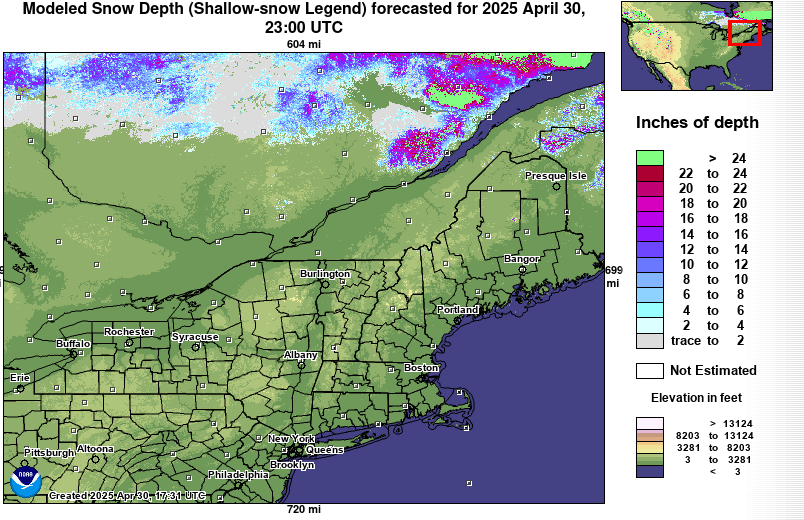
As you can see from the map above, our current snowpack is literally "off the charts." The green color shows theinches of depth accoring to the NWS model. We actually have around 30 inches as I found out yesterday, postholing over to our greenhouse to know off some snow that threatened to topple the thing.

But there's more to come! Up to 24 inches in the next 36 hours. I've given up worrying about snow load on the various house roofs. With the baby, there's just not enough time to keep up with it. The glass greenhouse is a goner whatever happens -- we plan to demolish it this spring to make room for a berry patch.

Luckily all the snow so far has been cold, light, fluffy stuff. That means no power outages, at least since the four-day one in November.

With the new block heaters, I know the Rover and tractor will start once all this is over. Both are fueled up. I already brought in the trailer load of hay that I'd had stored outside under a tarp. The main things to do today are to bring in enough firewood for the duration, get some fuel for the tractor, and to make sure we have enough bread and milk. I also need to post-hole over to the propane tank and check the level.

In other news, Roo has begun to sleep in her own crib, and to sleep through the night most nights. Eight hours sleep isn't much to ask for, if you ask most ordinary folks, but to a parent of a five-month old, it's a godsend.

Here's a Roo-fix for those who need it. I introduced her to the carving Grandad made of me chasing these pigs here. Ithink she quite liked it.


Monday, February 9, 2015

Magnetic


The weather continues to be normal. Very normal.

Which means snow. Lots of it.

The Land Rover cold starting problem had to be fixed. This is something of which I was aware last winter, but it wasn't a problem back then because there wasn't a snow plow that I needed to use on the front of the vehicle. Now there is.

The solution was the magnetic block heater above. It attaches neatly to the starter motor from either above or below, and puts out about 300 degrees F. I also used it on the tractor, but now I have a replacement cable for the tractor's block heater, so we should be alright there.

Now we have a three day snowstorm with very cold temperatures. The Land Rover starts easily after an hour or so of heating. The snow gets plowed. No problem.

I'm sure something else will happen. It always does. But we're entering the racing days. Not long now.

We'll still have snow until April, but the sunshine will get warmer, which makes life a lot nicer.
 

Thursday, February 5, 2015

A slight problem...


We had another snowstorm Monday, and got another snow day off work as a result. Accordingly we had a nice day taking it in turns to work on college paperwork and lounge around the house playing with Roo. I knew at some point I'd have to go out to move snow, but with the storm lingering into the late afternoon, and forecast to continue to spin much of the evening and night time, there wasn't much point in getting out there earlier.

I'd just taken a shower and was changing to my evening "comfy" clothes of sweatpants and sweatshirt when a commotion occured and Aimee burst into the bedroom holding Roo.

"The snow plow is stuck in the driveway", she said. "Again!" she might have added, since this is not the first nor likely the last time that this particular problem has occurred. Accordingly I pulled a set of insulated coveralls over my sweats and went out like a good husband to see what had happened.

Our driveway is actually a turning circle at the end of a town road. The road belongs to the town, the circle to us. Accordingly, the town plow doesn't actually have to plow our driveway, and perhaps shouldn't, but the truck does have to be turned around, so the drivers often go all the way around the circle for their own convenience. This is good for us, since it reduces the scale of our plowing chore by about two thirds, so we like those times when the circle gets plowed. At other times, with less accommodating drivers, the truck does a three-point turn at the junction with the town road. If the driver attempts to plow the circle, but doesn't know where the road is supposed to be, he can get well and truly stuck. But he can also get stuck doing a three point turn in a narrow road, so "pick your poison."

This time, the truck was stuck pretty much on top of one of my five feet tall snowbanks, having tried to drive straight over it. I found the hapless plow truck driver and neighbor Ham standing around scratching their heads about what to do.

Then ensued one of those Chinese fire drills, wherein five different guys each puts forward some notion of how to fix things, and each one is fervently tried, to no avail.

I wasn't much help myself. Although it was obvious that a smaller more maneuverable piece of snow-moving equipment would be needed to dig the bigger truck out, the cold had penetrated to the starter motors of both the Land Rover and the Kubota tractor. Both were frozen. At least, that's the best guess. The Rover's symptoms were clearer to diagnose -- the motor spinning without engaging the "Bendix" drive. That has happened before.

The tractor just clicked, a symptom that can be caused by anything from a seized engine through a dead battery to a ruined starter solenoid, of a jammed flywheel gear.

Either way, the upshot was I wouldn't be moving any of the snowbanks myself. Hamilton plowed with his old Dodge plow truck, while the plow truck drivers and I dug and then dug some more, stopping periodically to try to rock the truck in forward and reverse out of its snowbank. A second and third town plow arrived, meaning we now had five plow trucks on scene, plus my own Frontier which was just in the way. Eventually we'd moved all the snow that could be moved, and the big truck was still stuck. Some maneuvering of these vehicles was then required to get a second full-sized plow truck in place, with two strong chains, the proper amount of motive force was applied, and the first truck eventually popped out of its snowbank.

The town plow guys were then good enough to plow all my snow before leaving. I went inside for a well-earned dinner of fish pie, which I'd made earlier. I also ordered some additional block heaters online for both the tractor and the Rover. The tractor has one, but I'd lost the cable. I ordered an identical new one to get the cable. For the Rover, I ordered a magnetic heater to clamp directly to the starter motor.

Despite all the unexpected help I had moving snow this time, we were still pretty much snowed in the next day, with no Land Rover and no tractor to help. I began shoveling but was pleased when Hamilton came by and plowed the worst of the snow away with the Dodge. That was Tuesday morning. One of the two block heaters arrived Wednesday. Today, Thursday, we have eight more inches of snow before daylight, so I must go out with a power cord and fire up the block heater and try to get the Rover started and move snow.

I'm happy that I fitted the new heater in place last night, since I won't have to roll on my back in the snow at five am to do that today.

And so it goes. Winter. Another six weeks, says the groundhog.

Bloody old groundhog.


Thursday, January 29, 2015

Digging out


We received what looked like about twenty inches of snow Tuesday, the Great Blizzard of '15 according to the TV weathermen. It was hard to tell exactly how much because of the drifting. Here's our dooryard after my neighbor Ham and I had already plowed away the worst of the snow. You can see that the house is drifted in again, although not as deeply as a couple of years ago.

We had to push pretty hard to open that front door. I can easily imagine that sooner or later we'll get so much snow, we won't be able to open that door, which opens outwards, at all, and will have to exit by a different door. All it would take would be for the drift on the right to relocate a bit to the left.


Here's Aimee's little car drifted in pretty well. I'm glad we bought a black one and not a white.

The snow, light and fluffy, driven by a powerful wind, drifted in through the Rover's sliding glass windows, making for that ice cave look when I opened the door. Even so, it was a lot nicer sitting in the warm cab of the Land Rover than on the cold seat of the tractor. The inside of the Rover can get wet. After all, it sat uncovered in a junkyard for about ten years.


The new plow did a great job, despite the lightness of the truck, the light construction of the plow, and the depth of the snow. All in all, I'm pretty pleased with this device, which came from Home Depot, but was made by a Canadian firm. I guess Canadians know their snow.

Even so, the Rover and tractor both got stuck once before the job was done. There was a lot of snow.


One important consideration when plowing is that you have to clear out the mail box pretty good, or our mail lady just drives on by.


The plow blade is hinged and tilts up when it encounters an immovable pile of snow or ice, reducing the impact to the frame, and allowing you to pile snow higher with multiple sweeps.


The garage was well hidden.


This is after I cleared most of the snow away with the tractor. I always leave a foot or two to be cleared by hand because the garage's sliding metal door will bend if I hit it with the loader.